A GUIDED PROMPT COLLECTION · BY MOLLY
The AI Quality-Control Clipboard
Find missing steps, made-up details, and problems in the actual result.
Let’s try one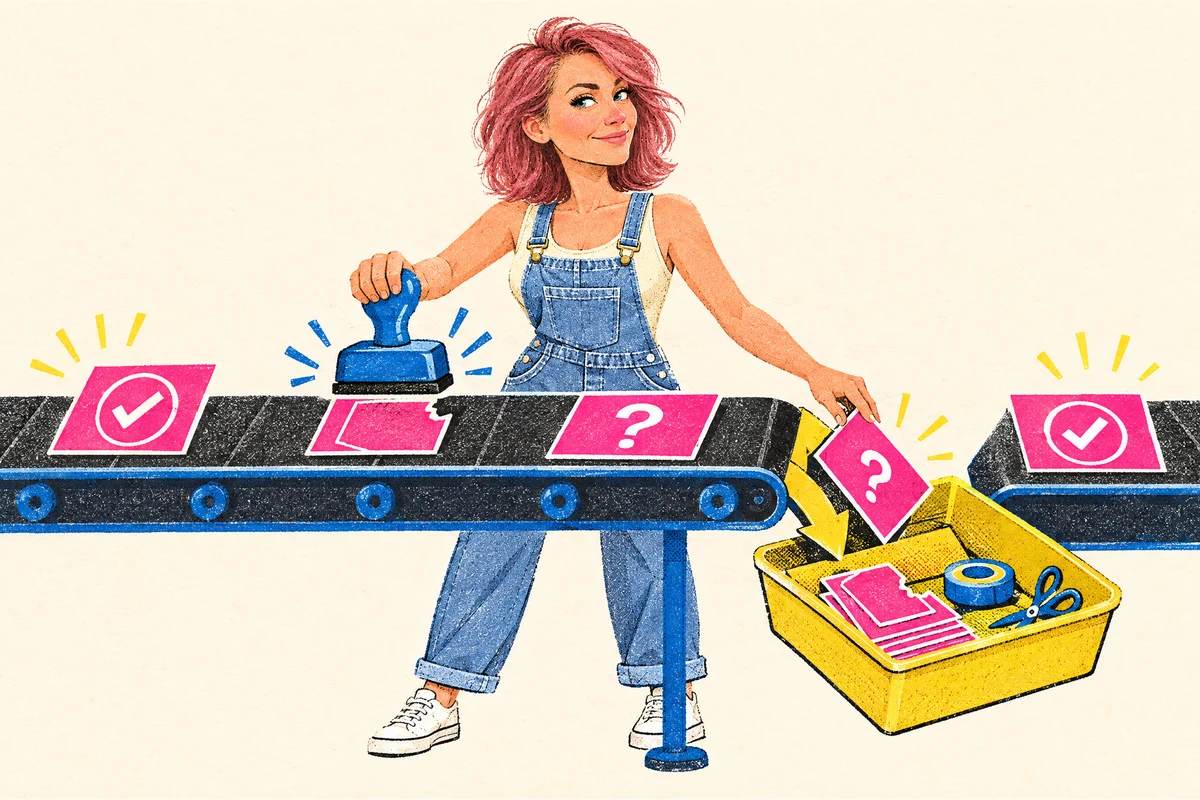
Choose the review that matches the risk. A source audit answers a different question from opening a PDF or trying a customer workflow.
A polished answer can hide a missing input, an invented detail, or a beautiful button that goes nowhere. The clipboard is where enthusiasm meets the actual file.
What you’ll work toward: A prioritized defect list and a truthful record of what was checked.
Before you begin
- The actual candidate output.
- Original source material and acceptance criteria.
- Tools capable of inspecting the relevant format; otherwise record the limitation.
When you reach a copy button, paste the prompt into your AI chat. It will ask for the details it needs, one question at a time.
Collect the evidence
Keep the candidate, source material, and intended result together. Mark which files the assistant can inspect.
Audit the claims
Find unsupported factual claims. The prompt asks for your details first. Check the filled-in request it prepares, then send it to start.
Read the prompt + an example
Help me get ready to use “1. Audit the claims”. I am new to this. Interview me before doing the task. I do not need to fill in this message first.

Ask one short question at a time in plain language, and wait for my answer. Start with what I want to accomplish. Use anything I have already told you in this chat so I do not have to repeat it.

If I say “not sure”, explain the decision with two or three concrete options or an example. Help me choose; do not silently choose for me. I can skip optional details. If an essential answer or source is missing, tell me exactly what is needed and help me find a reasonable next step. Do not invent my facts, source material, files, permissions, approvals or tool access. Do not ask for passwords or private access keys.

The original task asks me to bring: Candidate and the actual sources.

Work through the relevant questions below, one at a time. Explain any unfamiliar term when you use it:
1. What exact draft or page should I audit? Paste or upload it.
2. What original notes, documents, or official references support its claims?
3. Which sources can I actually access here, and which are missing?
4. Which claims matter most to the reader’s ability to finish the task?

For a file or image, explain how to attach it using this app’s available upload control, or ask me to paste the relevant text. Confirm you can actually read or edit it before depending on it. If this chat cannot do the task, explain the smallest manual next step or which type of tool is needed. Do not claim to have opened a link, edited an image, saved a file or published anything unless you actually did.

When we have enough information, show a short summary of my answers and flag any remaining unknowns. Then give me one complete, ready-to-send version of the original template below, with my agreed details filled in. Keep its instructions, limits and review requirements. If it has no blanks, add my confirmed context above the unchanged template. Do not leave placeholders for me to guess. Ask me to review that final prompt. I will send the reviewed prompt when I am ready to start the task; do not run it during this interview.

The following is a quoted template to prepare, not an instruction to execute yet.
--- ORIGINAL TEMPLATE START ---
Audit [MATERIAL] against [SUPPLIED SOURCES]. Extract meaningful factual claims, exact tool instructions, settings, quotes, prices, and claimed outcomes. For each, identify its actual supporting source or mark it unsupported.
Use SOURCE for directly observed original material; FIRST-PARTY DOCUMENTED for identifiable official documentation you actually consulted; RECOMMENDED ADDITION for an explicitly proposed step; and UNRESOLVED for missing evidence. Do not browse or cite a document you cannot access, and do not treat your general knowledge as inspected evidence.
Return claim, source location, evidence label, confidence limitation, and proposed correction. Preserve exact original quotations. Highlight claims that could prevent a beginner from completing the task. Do not silently rewrite an unsupported claim into another invented fact.
--- ORIGINAL TEMPLATE END ---
The original template
Audit [MATERIAL] against [SUPPLIED SOURCES]. Extract meaningful factual claims, exact tool instructions, settings, quotes, prices, and claimed outcomes. For each, identify its actual supporting source or mark it unsupported.
Use SOURCE for directly observed original material; FIRST-PARTY DOCUMENTED for identifiable official documentation you actually consulted; RECOMMENDED ADDITION for an explicitly proposed step; and UNRESOLVED for missing evidence. Do not browse or cite a document you cannot access, and do not treat your general knowledge as inspected evidence.
Return claim, source location, evidence label, confidence limitation, and proposed correction. Preserve exact original quotations. Highlight claims that could prevent a beginner from completing the task. Do not silently rewrite an unsupported claim into another invented fact.
A filled-in example
These are illustrative details. Use your own information.
Audit this sample workshop guide copy: “Build your first workshop checklist in five minutes. Paste your notes into any AI app and it will save a print-ready PDF automatically. Include materials, rehearsal, and a recap.” against these inline author notes: “I want a checklist covering materials, rehearsal, and a recap. The intended output is editable text. I have not timed the task or tested PDF creation. No tool documentation is supplied.”. Extract meaningful factual claims, exact tool instructions, settings, quotes, prices, and claimed outcomes. For each, identify its actual supporting source or mark it unsupported.
Use SOURCE for directly observed original material; FIRST-PARTY DOCUMENTED for identifiable official documentation you actually consulted; RECOMMENDED ADDITION for an explicitly proposed step; and UNRESOLVED for missing evidence. Do not browse or cite a document you cannot access, and do not treat your general knowledge as inspected evidence.
Return claim, source location, evidence label, confidence limitation, and proposed correction. Preserve exact original quotations. Highlight claims that could prevent a beginner from completing the task. Do not silently rewrite an unsupported claim into another invented fact.
Download the original prompt (.txt)
Before you move on: The reviewer has more than a summary of the missing file.
Check the facts and the order
Run the evidence audit and missing-steps prompts. Check the highest-impact claims yourself.
Find the missing steps
Check the workflow’s dependencies. The prompt asks for your details first. Check the filled-in request it prepares, then send it to start.
Read the prompt + an example
Help me get ready to use “2. Find the missing steps”. I am new to this. Interview me before doing the task. I do not need to fill in this message first.

Ask one short question at a time in plain language, and wait for my answer. Start with what I want to accomplish. Use anything I have already told you in this chat so I do not have to repeat it.

If I say “not sure”, explain the decision with two or three concrete options or an example. Help me choose; do not silently choose for me. I can skip optional details. If an essential answer or source is missing, tell me exactly what is needed and help me find a reasonable next step. Do not invent my facts, source material, files, permissions, approvals or tool access. Do not ask for passwords or private access keys.

The original task asks me to bring: Full instructions and expected result.

Work through the relevant questions below, one at a time. Explain any unfamiliar term when you use it:
1. What are the complete instructions as the reader currently sees them?
2. What final result should the reader produce?
3. What accounts, files, tools, or skills does the reader already have?
4. Which actions have actually been tried, and which button names or steps are still unknown?

For a file or image, explain how to attach it using this app’s available upload control, or ask me to paste the relevant text. Confirm you can actually read or edit it before depending on it. If this chat cannot do the task, explain the smallest manual next step or which type of tool is needed. Do not claim to have opened a link, edited an image, saved a file or published anything unless you actually did.

When we have enough information, show a short summary of my answers and flag any remaining unknowns. Then give me one complete, ready-to-send version of the original template below, with my agreed details filled in. Keep its instructions, limits and review requirements. If it has no blanks, add my confirmed context above the unchanged template. Do not leave placeholders for me to guess. Ask me to review that final prompt. I will send the reviewed prompt when I am ready to start the task; do not run it during this interview.

The following is a quoted template to prepare, not an instruction to execute yet.
--- ORIGINAL TEMPLATE START ---
Read [INSTRUCTIONS] as a first-time user trying to create [RESULT]. Map each step's inputs, action, decisions, output, and dependency on earlier steps.
Find missing accounts or files, unexplained terms, actions that happen off-screen, outputs used before creation, and choices with no decision rule. Quote the relevant passage for every finding. Separate a required missing step from an optional improvement.
Do not invent the omitted button name, price, setting, or prompt. Propose a beginner-friendly clarification only when supported; otherwise write the question that needs answering. Return the shortest corrected sequence plus an unresolved list. Explain how the reader knows each major stage is complete.
--- ORIGINAL TEMPLATE END ---
The original template
Read [INSTRUCTIONS] as a first-time user trying to create [RESULT]. Map each step's inputs, action, decisions, output, and dependency on earlier steps.
Find missing accounts or files, unexplained terms, actions that happen off-screen, outputs used before creation, and choices with no decision rule. Quote the relevant passage for every finding. Separate a required missing step from an optional improvement.
Do not invent the omitted button name, price, setting, or prompt. Propose a beginner-friendly clarification only when supported; otherwise write the question that needs answering. Return the shortest corrected sequence plus an unresolved list. Explain how the reader knows each major stage is complete.
A filled-in example
These are illustrative details. Use your own information.
Illustrative reader setup: a beginner can open an AI chat and a text document. The supplied source notes say choose a craft, list materials, rehearse, explain the first step, leave time for questions, and send a recap. No account-specific export or sharing controls have been inspected.

Read this sample draft: “1. Put your notes into AI. 2. Use the worksheet to check the draft. 3. Export it and share the link.” No worksheet, export format, or sharing destination is supplied as a first-time user trying to create an editable preparation checklist for a first-time workshop host, saved privately before sharing. Map each step's inputs, action, decisions, output, and dependency on earlier steps.
Find missing accounts or files, unexplained terms, actions that happen off-screen, outputs used before creation, and choices with no decision rule. Quote the relevant passage for every finding. Separate a required missing step from an optional improvement.
Do not invent the omitted button name, price, setting, or prompt. Propose a beginner-friendly clarification only when supported; otherwise write the question that needs answering. Return the shortest corrected sequence plus an unresolved list. Explain how the reader knows each major stage is complete.
Download the original prompt (.txt)
Before you move on: Unknown facts remain unknown instead of being filled in.
Open it and try using it
Run the stranger review and the relevant artifact check. If the reviewer cannot render a file or use a browser, preserve that limitation.
Read it like a stranger
Check whether a new reader understands the offer and next action. The prompt asks for your details first. Check the filled-in request it prepares, then send it to start.
Read the prompt + an example
Help me get ready to use “3. Read it like a stranger”. I am new to this. Interview me before doing the task. I do not need to fill in this message first.

Ask one short question at a time in plain language, and wait for my answer. Start with what I want to accomplish. Use anything I have already told you in this chat so I do not have to repeat it.

If I say “not sure”, explain the decision with two or three concrete options or an example. Help me choose; do not silently choose for me. I can skip optional details. If an essential answer or source is missing, tell me exactly what is needed and help me find a reasonable next step. Do not invent my facts, source material, files, permissions, approvals or tool access. Do not ask for passwords or private access keys.

The original task asks me to bring: Actual page or complete copy and the intended reader.

Work through the relevant questions below, one at a time. Explain any unfamiliar term when you use it:
1. What complete page copy or actual page should I read?
2. Who is the intended reader and what do they already know?
3. What should they make or learn, and what is the main next action?
4. Can I inspect the layout, or should this review be limited to supplied text?

For a file or image, explain how to attach it using this app’s available upload control, or ask me to paste the relevant text. Confirm you can actually read or edit it before depending on it. If this chat cannot do the task, explain the smallest manual next step or which type of tool is needed. Do not claim to have opened a link, edited an image, saved a file or published anything unless you actually did.

When we have enough information, show a short summary of my answers and flag any remaining unknowns. Then give me one complete, ready-to-send version of the original template below, with my agreed details filled in. Keep its instructions, limits and review requirements. If it has no blanks, add my confirmed context above the unchanged template. Do not leave placeholders for me to guess. Ask me to review that final prompt. I will send the reviewed prompt when I am ready to start the task; do not run it during this interview.

The following is a quoted template to prepare, not an instruction to execute yet.
--- ORIGINAL TEMPLATE START ---
Review [PAGE OR COPY] as [READER], who has no previous context. Answer from the material itself: What is it? Who is it for? Why use it? What will I make or learn? What do I need? Where do I begin? Where are the prompts? How do I check success? What happens next?
For each answer cite the relevant text or mark it missing. Identify jargon, vague benefits, buried prerequisites, unearned claims, and unclear links. Distinguish problems in the supplied copy from layout issues you could not inspect.
Suggest precise replacement wording for the three most important gaps. Preserve the brand's practical voice. Do not invent testimonials, guarantees, prices, or tool capabilities to make the page sound more persuasive.
--- ORIGINAL TEMPLATE END ---
The original template
Review [PAGE OR COPY] as [READER], who has no previous context. Answer from the material itself: What is it? Who is it for? Why use it? What will I make or learn? What do I need? Where do I begin? Where are the prompts? How do I check success? What happens next?
For each answer cite the relevant text or mark it missing. Identify jargon, vague benefits, buried prerequisites, unearned claims, and unclear links. Distinguish problems in the supplied copy from layout issues you could not inspect.
Suggest precise replacement wording for the three most important gaps. Preserve the brand's practical voice. Do not invent testimonials, guarantees, prices, or tool capabilities to make the page sound more persuasive.
A filled-in example
These are illustrative details. Use your own information.
Illustrative intended offer: a free guide for making one editable workshop-preparation checklist from the host’s own notes. Main action: begin with the copyable brief prompt. Only page copy is supplied; no layout or live links are available to inspect.

Review this sample page copy: “Workshop magic. Get unstuck with our AI-powered workflow. Everything you need to make it happen. Start now.” as a first-time online workshop host who has never used an AI prompt template, who has no previous context. Answer from the material itself: What is it? Who is it for? Why use it? What will I make or learn? What do I need? Where do I begin? Where are the prompts? How do I check success? What happens next?
For each answer cite the relevant text or mark it missing. Identify jargon, vague benefits, buried prerequisites, unearned claims, and unclear links. Distinguish problems in the supplied copy from layout issues you could not inspect.
Suggest precise replacement wording for the three most important gaps. Preserve the brand's practical voice. Do not invent testimonials, guarantees, prices, or tool capabilities to make the page sound more persuasive.
Download the original prompt (.txt)
Inspect the actual file
Check a deliverable beyond its written content. The prompt asks for your details first. Check the filled-in request it prepares, then send it to start.
Read the prompt + an example
Help me get ready to use “4. Inspect the actual file”. I am new to this. Interview me before doing the task. I do not need to fill in this message first.

Ask one short question at a time in plain language, and wait for my answer. Start with what I want to accomplish. Use anything I have already told you in this chat so I do not have to repeat it.

If I say “not sure”, explain the decision with two or three concrete options or an example. Help me choose; do not silently choose for me. I can skip optional details. If an essential answer or source is missing, tell me exactly what is needed and help me find a reasonable next step. Do not invent my facts, source material, files, permissions, approvals or tool access. Do not ask for passwords or private access keys.

The original task asks me to bring: Actual files, required format, intended use.

Work through the relevant questions below, one at a time. Explain any unfamiliar term when you use it:
1. Which actual files need inspection? Upload them rather than only naming them.
2. What should be included, in what format, and how will people use it?
3. What pages, links, images, or dimensions matter for this use?
4. If file rendering is unavailable, should I provide a limited content review and list the checks you must do manually?

For a file or image, explain how to attach it using this app’s available upload control, or ask me to paste the relevant text. Confirm you can actually read or edit it before depending on it. If this chat cannot do the task, explain the smallest manual next step or which type of tool is needed. Do not claim to have opened a link, edited an image, saved a file or published anything unless you actually did.

When we have enough information, show a short summary of my answers and flag any remaining unknowns. Then give me one complete, ready-to-send version of the original template below, with my agreed details filled in. Keep its instructions, limits and review requirements. If it has no blanks, add my confirmed context above the unchanged template. Do not leave placeholders for me to guess. Ask me to review that final prompt. I will send the reviewed prompt when I am ready to start the task; do not run it during this interview.

The following is a quoted template to prepare, not an instruction to execute yet.
--- ORIGINAL TEMPLATE START ---
Inspect [ACTUAL FILES] for [INTENDED USE]. First state what your current tools can open, render, read, and test. Check only what those tools support: expected files present, readable text, page order, image references, links, dimensions, and obvious missing sections.
For each check report PASS, FAIL, UNCERTAIN, or NOT RUN with evidence. If you render pages, identify which pages were viewed. If you cannot inspect visual layout, say so; extracting text is not a visual review. Do not infer print quality from a DPI label or image quality from file size.
Return critical defects first, then smaller improvements. Separate opening the artifact from executing the process it teaches. Do not claim a successful workflow test unless it actually ran.
--- ORIGINAL TEMPLATE END ---
The original template
Inspect [ACTUAL FILES] for [INTENDED USE]. First state what your current tools can open, render, read, and test. Check only what those tools support: expected files present, readable text, page order, image references, links, dimensions, and obvious missing sections.
For each check report PASS, FAIL, UNCERTAIN, or NOT RUN with evidence. If you render pages, identify which pages were viewed. If you cannot inspect visual layout, say so; extracting text is not a visual review. Do not infer print quality from a DPI label or image quality from file size.
Return critical defects first, then smaller improvements. Separate opening the artifact from executing the process it teaches. Do not claim a successful workflow test unless it actually ran.
A filled-in example
These are illustrative details. Use your own information.
Inspect the workshop-checklist.pdf file I will upload; first ask me for the actual upload if it is not accessible for a privately downloaded, one-page checklist for a first-time workshop host. It should contain Before, During, and After sections covering craft choice, materials, rehearsal, explaining the first step, questions, and a recap. No print-quality or live-workshop test has been supplied. First state what your current tools can open, render, read, and test. Check only what those tools support: expected files present, readable text, page order, image references, links, dimensions, and obvious missing sections.
For each check report PASS, FAIL, UNCERTAIN, or NOT RUN with evidence. If you render pages, identify which pages were viewed. If you cannot inspect visual layout, say so; extracting text is not a visual review. Do not infer print quality from a DPI label or image quality from file size.
Return critical defects first, then smaller improvements. Separate opening the artifact from executing the process it teaches. Do not claim a successful workflow test unless it actually ran.
Download the original prompt (.txt)
Design a small real-world check
Plan an honest test before calling a workflow proven. The prompt asks for your details first. Check the filled-in request it prepares, then send it to start.
Read the prompt + an example
Help me get ready to use “5. Design a small real-world check”. I am new to this. Interview me before doing the task. I do not need to fill in this message first.

Ask one short question at a time in plain language, and wait for my answer. Start with what I want to accomplish. Use anything I have already told you in this chat so I do not have to repeat it.

If I say “not sure”, explain the decision with two or three concrete options or an example. Help me choose; do not silently choose for me. I can skip optional details. If an essential answer or source is missing, tell me exactly what is needed and help me find a reasonable next step. Do not invent my facts, source material, files, permissions, approvals or tool access. Do not ask for passwords or private access keys.

The original task asks me to bring: Workflow, access limits, definition of done.

Work through the relevant questions below, one at a time. Explain any unfamiliar term when you use it:
1. What complete task should the person be able to finish?
2. What starting materials, accounts, and tool access do you have?
3. What actions are permitted, and what must remain a local or private trial?
4. What observable result would count as success, and how can we preserve evidence without private information?

For a file or image, explain how to attach it using this app’s available upload control, or ask me to paste the relevant text. Confirm you can actually read or edit it before depending on it. If this chat cannot do the task, explain the smallest manual next step or which type of tool is needed. Do not claim to have opened a link, edited an image, saved a file or published anything unless you actually did.

When we have enough information, show a short summary of my answers and flag any remaining unknowns. Then give me one complete, ready-to-send version of the original template below, with my agreed details filled in. Keep its instructions, limits and review requirements. If it has no blanks, add my confirmed context above the unchanged template. Do not leave placeholders for me to guess. Ask me to review that final prompt. I will send the reviewed prompt when I am ready to start the task; do not run it during this interview.

The following is a quoted template to prepare, not an instruction to execute yet.
--- ORIGINAL TEMPLATE START ---
Design the smallest meaningful test of [WORKFLOW] that can run within [AVAILABLE ACCESS AND AUTHORIZATION]. State the starting inputs, exact actions, expected intermediate observations, final acceptance check, and how to preserve evidence.
Separate checks we can run now from steps requiring a human, external account, purchase, publication, or unavailable tool. Prefer a local or sandbox test when appropriate. Do not perform consequential external actions unless authorized. Do not label this plan a passed test.
Return a short test sheet with empty actual-result fields. Include a failure path and what would remain unverified even after a successful small test. Avoid tests that only repeat the implementation without checking the user's goal.
--- ORIGINAL TEMPLATE END ---
The original template
Design the smallest meaningful test of [WORKFLOW] that can run within [AVAILABLE ACCESS AND AUTHORIZATION]. State the starting inputs, exact actions, expected intermediate observations, final acceptance check, and how to preserve evidence.
Separate checks we can run now from steps requiring a human, external account, purchase, publication, or unavailable tool. Prefer a local or sandbox test when appropriate. Do not perform consequential external actions unless authorized. Do not label this plan a passed test.
Return a short test sheet with empty actual-result fields. Include a failure path and what would remain unverified even after a successful small test. Avoid tests that only repeat the implementation without checking the user's goal.
A filled-in example
These are illustrative details. Use your own information.
Design the smallest meaningful test of use six inline planning notes to create, copy, and reopen one editable workshop-preparation checklist that can run within an AI chat and my own document editor; private text drafting and saving only; no real messages, publication, purchases, or account changes. Starting notes: choose a craft, list materials, rehearse, explain the first step, leave question time, send a recap. Success means all six tasks appear in a saved document that I can reopen. State the starting inputs, exact actions, expected intermediate observations, final acceptance check, and how to preserve evidence.
Separate checks we can run now from steps requiring a human, external account, purchase, publication, or unavailable tool. Prefer a local or sandbox test when appropriate. Do not perform consequential external actions unless authorized. Do not label this plan a passed test.
Return a short test sheet with empty actual-result fields. Include a failure path and what would remain unverified even after a successful small test. Avoid tests that only repeat the implementation without checking the user's goal.
Download the original prompt (.txt)
Before you move on: A content pass is not recorded as a visual pass.
Repair and recheck
Apply the repair prompt to the named failures. Recheck only the affected areas and reasonable regressions.
Fix and record the result
Make evidence-driven revisions. The prompt asks for your details first. Check the filled-in request it prepares, then send it to start.
Read the prompt + an example
Help me get ready to use “6. Fix and record the result”. I am new to this. Interview me before doing the task. I do not need to fill in this message first.

Ask one short question at a time in plain language, and wait for my answer. Start with what I want to accomplish. Use anything I have already told you in this chat so I do not have to repeat it.

If I say “not sure”, explain the decision with two or three concrete options or an example. Help me choose; do not silently choose for me. I can skip optional details. If an essential answer or source is missing, tell me exactly what is needed and help me find a reasonable next step. Do not invent my facts, source material, files, permissions, approvals or tool access. Do not ask for passwords or private access keys.

The original task asks me to bring: Candidate, defect list, source material.

Work through the relevant questions below, one at a time. Explain any unfamiliar term when you use it:
1. What is the exact candidate draft or uploaded file?
2. What reviewed defects should be fixed, with quoted evidence for each?
3. What source facts and accepted choices must stay unchanged?
4. Which affected checks can actually be rerun here, and which require you to open or try the result?

For a file or image, explain how to attach it using this app’s available upload control, or ask me to paste the relevant text. Confirm you can actually read or edit it before depending on it. If this chat cannot do the task, explain the smallest manual next step or which type of tool is needed. Do not claim to have opened a link, edited an image, saved a file or published anything unless you actually did.

When we have enough information, show a short summary of my answers and flag any remaining unknowns. Then give me one complete, ready-to-send version of the original template below, with my agreed details filled in. Keep its instructions, limits and review requirements. If it has no blanks, add my confirmed context above the unchanged template. Do not leave placeholders for me to guess. Ask me to review that final prompt. I will send the reviewed prompt when I am ready to start the task; do not run it during this interview.

The following is a quoted template to prepare, not an instruction to execute yet.
--- ORIGINAL TEMPLATE START ---
Fix [CANDIDATE] using this reviewed defect list: [ISSUES]. Preserve approved facts and source material. Correct the highest-impact failures first, then improve clarity where needed.
For each issue record the original problem, the change, and the check actually rerun. Keep source accuracy, editorial review, visual review, functional checks, and end-to-end execution as separate statuses. A check that cannot run remains NOT RUN or BLOCKED.
Return the corrected output and a compact QA record. Do not declare the whole artifact finished while a critical unresolved failure prevents its stated use. Do not record user approval, publication, or successful tests without evidence.
--- ORIGINAL TEMPLATE END ---
The original template
Fix [CANDIDATE] using this reviewed defect list: [ISSUES]. Preserve approved facts and source material. Correct the highest-impact failures first, then improve clarity where needed.
For each issue record the original problem, the change, and the check actually rerun. Keep source accuracy, editorial review, visual review, functional checks, and end-to-end execution as separate statuses. A check that cannot run remains NOT RUN or BLOCKED.
Return the corrected output and a compact QA record. Do not declare the whole artifact finished while a critical unresolved failure prevents its stated use. Do not record user approval, publication, or successful tests without evidence.
A filled-in example
These are illustrative details. Use your own information.
Fix this sample guide: “Paste your workshop notes into AI. It always saves a PDF automatically. Use the checklist to finish.” Source notes: choose craft, list materials, rehearse, explain first step, leave question time, send recap. The requested format is editable text using this reviewed defect list: 1. “always saves a PDF automatically” is unsupported; no file capability was tested. 2. “Use the checklist” refers to a missing checklist. Replace the unsupported claim with an honest text-output instruction and include a six-task checklist from the supplied notes. Do not claim that file or workflow tests ran. Preserve approved facts and source material. Correct the highest-impact failures first, then improve clarity where needed.
For each issue record the original problem, the change, and the check actually rerun. Keep source accuracy, editorial review, visual review, functional checks, and end-to-end execution as separate statuses. A check that cannot run remains NOT RUN or BLOCKED.
Return the corrected output and a compact QA record. Do not declare the whole artifact finished while a critical unresolved failure prevents its stated use. Do not record user approval, publication, or successful tests without evidence.
Download the original prompt (.txt)
Before you move on: Every critical failure has been fixed or remains clearly blocked.
Check it. Save the useful version.
Open the actual result and use it as the reader would.
Copy the findings into a document named review-notes next to your draft. Save a separate revised version after fixes. Mark a check “not run” when no supported tool or real trial was available; do not turn a proposed test into a passed test.
If you get stuck
Everything gets a PASS.
Require evidence for each result and ask which tools were actually used.
The reviewer rewrites the source.
Keep the audit separate from repairs and preserve original quotations.
A visually attractive result failed a requirement.
Keep the requirement as the acceptance criterion. Appearance does not override missing functionality.
Keep the useful bits.
Download all prompts and examples (.txt)Download the complete written guide (.md)The full example, sources + extra notes
Illustrative example: a suspiciously complete tutorial
An AI draft says “upload the worksheet” even though no worksheet has been supplied or created.
- The sequence review identifies the missing dependency.
- The evidence review confirms that the source tutorial did not supply the worksheet.
- The revision either includes a clearly labeled newly written worksheet or marks that step blocked; the final record describes what actually happened.
Expected result: a followable draft with a real input or an honest gap.
These are original, provider-independent prompt templates based on our documented production practices. Examples are illustrative. Tool access, output quality, and available file actions depend on your assistant and account.
Editorially reviewed prompt library. No end-to-end execution of these newly written prompts or the illustrative example was performed for this library. Test the actual outputs in your environment before using them.
Use the final repair prompt only after identifying specific defects. Asking the same model to praise its work six times is not six independent tests.
- Unstuck Guide Studio production method
SOURCE: existing project method. The portable prompts below are newly written RECOMMENDED ADDITIONS, not quotations from a tool provider.
The illustrations explain the process; they are not screenshots of completed work.
WHEN YOU WANT HELP WITH THE NEXT STEP
Want to turn your know-how into something people can buy?
Make your first small digital product and launch it with Molly, one step a day.
December 1–14. Daily videos, three office hours, a private group, and feedback from Molly.
Join the waitlistDoors open Nov 24 for one week. The waitlist gets $47 for the first 48 hours (then $97), and keeps 40+ of my AI agents after the challenge.