A FREE PRACTICAL GUIDE · BY MOLLY
Make the Small Version First
Choose one useful thing to finish, and leave the extras for later.
Let’s try one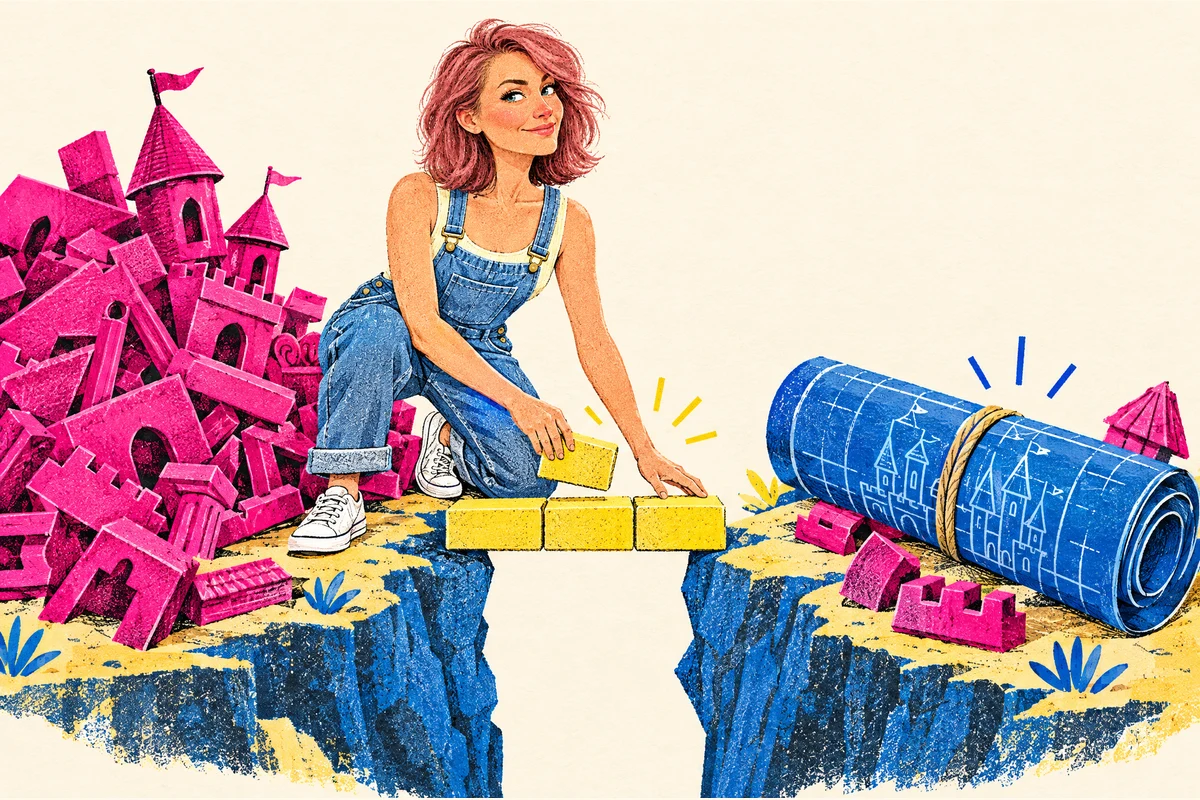
Your idea has grown a shop, a website and possibly an app. Let's find the piece you could start with now.
Who it's for
You have a big idea and it's been “almost ready to start” for months. It could be a course or an app, but just as often it's a bakery, a product line, a class you'd teach, a service, an event or a community project.
Use it when
- Your idea picks up a new part every time you think about it.
- You've bought the domain, the equipment or the supplies, but there's nothing anyone can buy or sign up for yet.
- You want to know if anyone will pay or show up before you spend months or savings on it.
- Someone asked “can I buy that?” and you had nothing to send them.
You'll get: The one small thing to make first, a rough price and where to sell it, and a list that keeps the rest of your idea for later.
How to do it
Write down every part of the big idea
Make a quick list of everything you've imagined: the shop, the website, the full product range, the classes, the videos, the app. All of it.
What good looks like: A list, not a paragraph. Seeing it all written down is what makes it OK to set most of it aside.
Watch out for: Keeping it in your head, where every part feels equally urgent.
Pick one person and their most annoying problem
Think of one real person who'd use this. What's the one thing that annoys them most?
What good looks like: You can name someone who has the problem, and say it in their words.
Watch out for: Saying it's for “everyone” or “beginners”. That makes it impossible to pick what goes in.
Find the piece that solves only that problem
Look at your list and find the smallest part that fixes that one problem on its own. Give it a rough price by checking what similar things sell for.
What good looks like: Something you could make or offer within a couple of weeks: one product instead of a range, one class instead of a school, a pop-up or a market stall instead of a shop, one service for a few people you already know, or a PDF or checklist.
Watch out for: Picking the shop, the app, the website, the lease or the membership as the first thing. Those are containers, not contents.
Put everything else on a later list
Every other part of the idea goes on a list called “Later”. Nothing is deleted.
What good looks like: Each part of the big idea has a home, so you can stop thinking about it for now.
Watch out for: Cramming “just one more” part into the small version until it's big again.
Ask one person before you make it
Send one sentence to someone who has the problem: “I'm making [the small thing] for [who it's for]. Would that have helped you?”
What good looks like: You ask about their problem, not about your idea.
Watch out for: Asking “do you like my idea?” People are kind, and a compliment isn't a buyer.
Do it with Claude in 10 minutes
This prompt walks you through all five steps in about 10 minutes. Claude asks a few quick questions, one at a time, then gives you the small version, two other options, a rough price and where to sell it, your later list and the message to send.
Find the small version of my idea
Shrink a big idea into one small thing you could finish soon. Paste it into Claude and answer its few quick questions. The result comes back in the same chat.
Read the prompt + an example
I have a big idea that keeps stalling because it's too big. It might be digital, a physical product, a service, a class, an event or a local business. Help me find the smallest version I could make or offer soon and get paid for.

To do this well, you'll probably need to find out:
- the big idea, with all the parts I've imagined
- who it's for
- the one problem that annoys them most

How I'd like you to work:
- I have about 10 minutes and I'm on my phone, so start straight away with your first question. No introduction.
- Ask one short question at a time and wait for my answer.
- You decide what to ask. Before each question, say in a few words why you're asking.
- When it helps, give me 2 to 4 numbered choices, with the one you'd recommend first and "something else" last, so I can reply with a number.
- If an answer is vague, ask for one real example instead of guessing.
- Use what I've already told you, and don't ask for anything you could work out or suggest yourself.
- Stop asking once you know enough to do a good job without guessing. That's usually three to five questions. If I say "just do it", make your best guess and tell me what you assumed.
- Then give me the result straight away. Write it for a phone screen: plain words, short lines, no tables, no jargon.

When you have enough, give me:
- The one smallest thing I could make or offer soon that solves that problem on its own: a name, what's inside, and what form it takes. Match my kind of idea: for a physical product, one item or a small batch; for a service or class, one session for a few people; for a shop or venue, a pop-up, market stall or pre-order; for a digital idea, a PDF, checklist, template or short video.
- Two other small options, one line each.
- A rough starting price and the simplest place to sell it, starting with people I already know if I have them. Remind me to check what similar things sell for.
- A "later" list with every other part of my big idea, so nothing is lost.
- One sentence I could send to someone who'd use it, to ask if they'd want it.

Don't suggest an app, a website, a membership, a lease or a big stock order as the first step.
A filled-in example
These are illustrative details. Use your own information.
I have a big idea that keeps stalling because it's too big. It might be digital, a physical product, a service, a class, an event or a local business. Help me find the smallest version I could make or offer soon and get paid for.

To do this well, you'll probably need to find out:
- the big idea, with all the parts I've imagined
- who it's for
- the one problem that annoys them most

How I'd like you to work:
- I have about 10 minutes and I'm on my phone, so start straight away with your first question. No introduction.
- Ask one short question at a time and wait for my answer.
- You decide what to ask. Before each question, say in a few words why you're asking.
- When it helps, give me 2 to 4 numbered choices, with the one you'd recommend first and "something else" last, so I can reply with a number.
- If an answer is vague, ask for one real example instead of guessing.
- Use what I've already told you, and don't ask for anything you could work out or suggest yourself.
- Stop asking once you know enough to do a good job without guessing. That's usually three to five questions. If I say "just do it", make your best guess and tell me what you assumed.
- Then give me the result straight away. Write it for a phone screen: plain words, short lines, no tables, no jargon.

When you have enough, give me:
- The one smallest thing I could make or offer soon that solves that problem on its own: a name, what's inside, and what form it takes. Match my kind of idea: for a physical product, one item or a small batch; for a service or class, one session for a few people; for a shop or venue, a pop-up, market stall or pre-order; for a digital idea, a PDF, checklist, template or short video.
- Two other small options, one line each.
- A rough starting price and the simplest place to sell it, starting with people I already know if I have them. Remind me to check what similar things sell for.
- A "later" list with every other part of my big idea, so nothing is lost.
- One sentence I could send to someone who'd use it, to ask if they'd want it.

Don't suggest an app, a website, a membership, a lease or a big stock order as the first step.

---
HOW IT GOES (a made-up example)
Claude: What's the big idea? Put in every part you've imagined. (So nothing gets lost.)
You: A bakery café with a full menu, catering and baking classes.
Claude: Who's it for first? 1. Neighbors 2. Offices 3. Parents planning parties 4. Something else
You: 3
…two more short questions, then the small version: birthday cake pre-orders for parents at your kids' school, taken by message and picked up on Saturdays.
Download the original prompt (.txt)
See it in action
Molly shrinks her big idea. This is a real one: Molly ran her own big idea through this prompt, and the small version became the Ready to Sell Challenge.
What's the big idea? Put in every part you've imagined.
A business studio where a team of AI agents runs a whole side business for you: the product, the store, the marketing, all of it.
Who's it for? 1. People with a job who want something of their own 2. Small business owners 3. Freelancers 4. Something else
1
What stops them most? 1. Picking an idea 2. The tech 3. Time 4. Something else
The tech, and not knowing where to start.
Smallest version: a 14-day challenge where Claude helps someone make one small product and its buy link, 20 minutes a day. The full studio, the marketing team and the automation go on your later list.
What to do next
Send the message. If they say yes, make the small version next. If they say no, ask what would have helped. That answer is often your real small version.
Your answer stays in your Claude chat. To find it faster, screenshot it or copy it into your notes.
WHEN YOU WANT HELP WITH THE NEXT STEP
Found something you could make? Let’s give it a buy link.
Turn that idea into a product, a sales page, and your first invitation to buy—with Molly’s help.
December 1–14. Daily videos, three office hours, a private group, and feedback from Molly.
Join the waitlistDoors open Nov 24 for one week. The waitlist gets $47 for the first 48 hours (then $97), and keeps 40+ of my AI agents after the challenge.