A FREE PRACTICAL GUIDE · BY MOLLY
Turn One Guide Into Several Useful Posts
Get five post ideas and one finished post from a guide, card or handout you've already made.
Let’s try one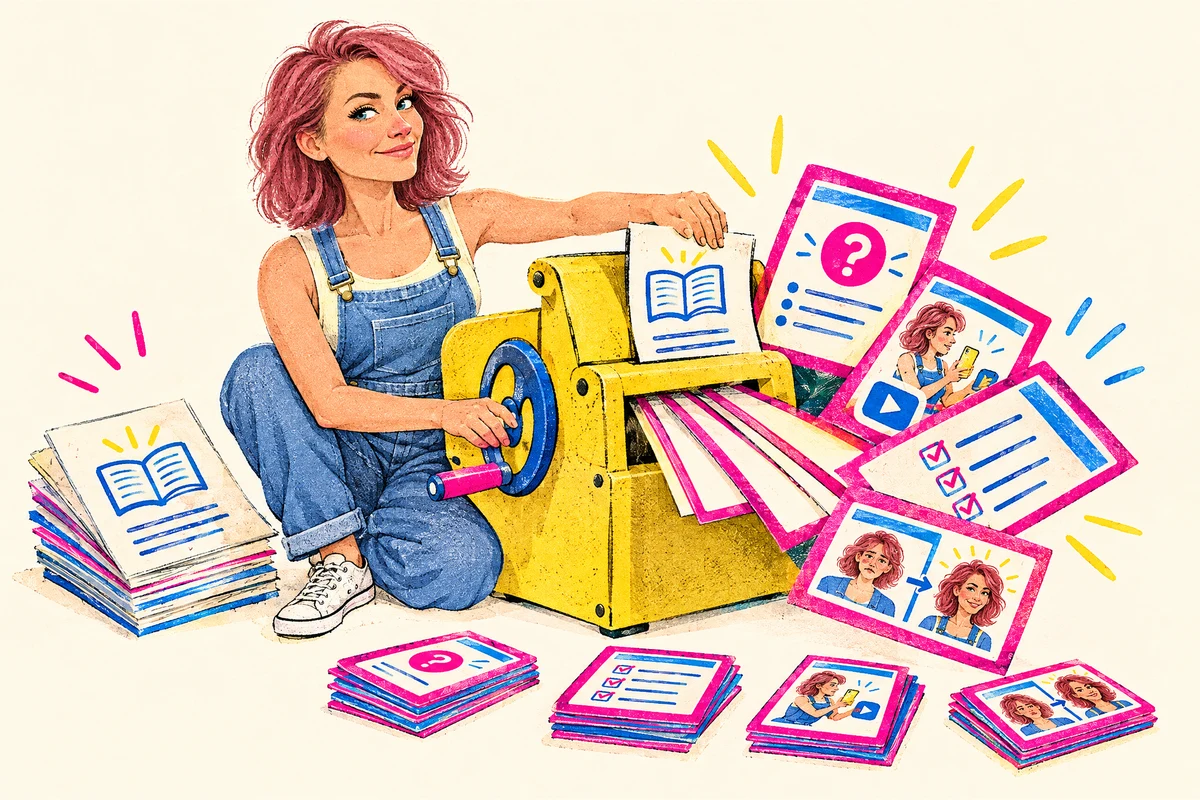
You did the hard part when you made the guide. Each useful piece of it can be its own post.
Who it's for
Anyone who has made one useful thing to hand out, like a guide, a care card, a recipe sheet, a class handout or a checklist, and wants more people to find it without posting the same thing five times. It works for Instagram or Facebook, a WhatsApp or community group, texts to your regulars, or a sign by the till.
Use it when
- You made a free guide or handout, shared it once, and haven't mentioned it since.
- You run a class, a salon, a stall or a shop and hand out a printed card: aftercare, care instructions, what to bring. You'd like new people to see the useful bits too, in your Facebook group, on Instagram or on the noticeboard.
- You sit down to post and have no idea what to say, even though you know you've got something useful somewhere.
- Every post about your guide ends up saying “it's really helpful, go get it”.
You'll get: Five post ideas that each answer a different question, the first post written for wherever you share things, and one honest line telling people how to get the full guide.
How to do it
Pick one guide and the person it helps
Choose one thing you've already made: a free guide, a care card, a class handout, a recipe sheet, a checklist. Then name the one kind of person it helps, the way you'd describe them out loud.
What good looks like: One guide and one person, like “new puppy owners after their first groom” or “people who just took my beginner pottery class”.
Watch out for: Starting from “what should I post?” with nothing in front of you. Posts come easily when they come from something that already helps.
Turn it into five different questions
Each post answers one question that person has. Use the questions people really ask you. If none come to mind, try these five: What do people get wrong? What's one small step to try today? What does it look like done well? What do people always ask? How do you know it's working?
What good looks like: Five questions with five different answers. If two posts would end up saying the same thing, drop one.
Watch out for: Five posts that all say “my guide helps with this” in slightly different words.
Give the whole answer in the post
Each post should help someone who never opens your guide. A mistake post says what to do instead. A tip post gives the actual tip. Keep the full set of steps for the guide.
What good looks like: Someone could read only the post and do one thing differently today.
Watch out for: Holding back the answer to make people click: “Find out the number one mistake in my guide.” It feels like a trick, and most people scroll past.
Write one post for the place your people already look
Pick the post that's easiest to explain and write only that one. Fit it to where it's going: a short caption for Instagram, Facebook or LinkedIn, a few lines for a group chat, a text to your regulars, or a printed sign or card by the till.
What good looks like: One post finished and shared where your people already are.
Watch out for: Planning graphics, a schedule and all five posts before you share any. One shared post teaches you more than five drafts.
Check it against your guide, then add one next step
Read the post next to your guide. Take out anything that promises more than the guide does. End with one honest next step: a link, “ask me for the card at your next visit”, or “message me and I'll send it”.
What good looks like: Everything in the post is in your guide, and the next step works: the link opens, or you have cards ready to hand out.
Watch out for: Promising results your guide doesn't (“never lose a plant again”), or adding a link you haven't opened yourself.
Do it with Claude in 10 minutes
This prompt asks you a few questions, one at a time, then gives you five post ideas and writes the first one for wherever you share things. If your guide is written down, paste it in or send a photo of the printed card when Claude asks. To talk instead of type, use the microphone on your phone's keyboard.
Turn my guide into posts
Get five different post ideas from one guide and write the first one. Paste it into Claude and answer its few quick questions. The result comes back in the same chat.
Read the prompt + an example
I've made something useful for people: a guide, a handout, a care card, a checklist or something I always explain. Help me turn it into several short posts that each help someone on their own, and write the first one with me. I might share it on Instagram, Facebook or LinkedIn, in a WhatsApp or community group, in a text to my regulars, or on a printed sign or flyer.

To do this well, you'll probably need to find out these things. Each has a purpose. If I've already pasted my guide or told you something, build on it and skip that question:
- what my guide says (purpose: every post comes from what's really in it, not from guesses; ask me to paste it, send a photo of it, or just tell you the main steps)
- who it helps, in the words I'd use (purpose: so each post talks to one kind of person; try “who asked you about this most recently?”)
- the questions people ask me or the mistakes they make (purpose: each one can be its own post; try “what do you end up explaining again, even after people have read it?”)
- where I'll share the first post (purpose: a caption, a group message, a text and a printed sign are written differently)
- how people get the full guide from me (purpose: an honest next step; it might be a link, a printed card at my counter or “message me”; if there's no way yet, end the post with the small step instead)

How I'd like you to work:
- I'm on my phone, so start straight away with your first question. No introduction.
- Ask one short question at a time and wait for my answer. Say in a few words why you're asking.
- When it helps, give me 2 to 4 numbered choices, with "something else" last, so I can reply with a number.
- If an answer is vague, ask for one real example instead of guessing. Don't ask for anything you could work out from my guide.
- Stop once you have enough. That's usually three to five questions. If I say "just do it", make your best guess and tell me what you assumed.
- Write for a phone screen: plain words, short lines, no tables, no jargon.

When you have enough, give me:
- Up to five post ideas (fewer if my guide is short), each answering a different question, in one or two lines each: the question, and the one useful thing the post gives away. Mix the kinds: a common mistake and what to do instead, one small step to try, an example or before-and-after, a question people always ask, and a "you know it's working when..." check.
- Then ask which one to write first, so I can reply with a number. Recommend the easiest.
- Write that post for the place I'll share it: a caption for Instagram, Facebook or LinkedIn, a few lines for a group or a text, or short wording for a printed sign or flyer. For an Instagram carousel, give me the words for each slide, 5 slides at most. It should help someone who never opens my guide, and end with my next step.
- Under the post, list anything you added that isn't in my guide or my answers, one line each, so I can check it or cut it.
- Then ask if I'd like the next post, or this one shorter or friendlier.

Only use what's in my guide and what I've told you. Don't invent results, numbers, reviews or stories about me or my customers, and don't promise anything my guide doesn't. Use my words where you can. No hashtags unless I ask.
A filled-in example
These are illustrative details. Use your own information.
I've made something useful for people: a guide, a handout, a care card, a checklist or something I always explain. Help me turn it into several short posts that each help someone on their own, and write the first one with me. I might share it on Instagram, Facebook or LinkedIn, in a WhatsApp or community group, in a text to my regulars, or on a printed sign or flyer.

To do this well, you'll probably need to find out these things. Each has a purpose. If I've already pasted my guide or told you something, build on it and skip that question:
- what my guide says (purpose: every post comes from what's really in it, not from guesses; ask me to paste it, send a photo of it, or just tell you the main steps)
- who it helps, in the words I'd use (purpose: so each post talks to one kind of person; try “who asked you about this most recently?”)
- the questions people ask me or the mistakes they make (purpose: each one can be its own post; try “what do you end up explaining again, even after people have read it?”)
- where I'll share the first post (purpose: a caption, a group message, a text and a printed sign are written differently)
- how people get the full guide from me (purpose: an honest next step; it might be a link, a printed card at my counter or “message me”; if there's no way yet, end the post with the small step instead)

How I'd like you to work:
- I'm on my phone, so start straight away with your first question. No introduction.
- Ask one short question at a time and wait for my answer. Say in a few words why you're asking.
- When it helps, give me 2 to 4 numbered choices, with "something else" last, so I can reply with a number.
- If an answer is vague, ask for one real example instead of guessing. Don't ask for anything you could work out from my guide.
- Stop once you have enough. That's usually three to five questions. If I say "just do it", make your best guess and tell me what you assumed.
- Write for a phone screen: plain words, short lines, no tables, no jargon.

When you have enough, give me:
- Up to five post ideas (fewer if my guide is short), each answering a different question, in one or two lines each: the question, and the one useful thing the post gives away. Mix the kinds: a common mistake and what to do instead, one small step to try, an example or before-and-after, a question people always ask, and a "you know it's working when..." check.
- Then ask which one to write first, so I can reply with a number. Recommend the easiest.
- Write that post for the place I'll share it: a caption for Instagram, Facebook or LinkedIn, a few lines for a group or a text, or short wording for a printed sign or flyer. For an Instagram carousel, give me the words for each slide, 5 slides at most. It should help someone who never opens my guide, and end with my next step.
- Under the post, list anything you added that isn't in my guide or my answers, one line each, so I can check it or cut it.
- Then ask if I'd like the next post, or this one shorter or friendlier.

Only use what's in my guide and what I've told you. Don't invent results, numbers, reviews or stories about me or my customers, and don't promise anything my guide doesn't. Use my words where you can. No hashtags unless I ask.

---
HOW IT GOES (a made-up example)
Claude: What does your guide say? Paste it, send a photo, or tell me the main steps. (So every post comes from what's really in it.)
You: (pastes a yoga studio's “5 stretches for desk days” handout)
Claude: Who asks you about this most? 1. Office workers 2. People new to yoga 3. People with a sore back 4. Something else
You: 1
Claude: Where will you share the first post? 1. Instagram 2. The studio's WhatsApp group 3. A poster at reception 4. Something else
You: 2
…one more question, then five post ideas and the first message for the WhatsApp group, ending with “Grab the handout at the front desk.”
Download the original prompt (.txt)
See it in action
A dog groomer turns a brushing card into posts. A made-up example, to show how the chat goes.
What does your guide say? Paste it, send a photo of it, or tell me the main steps. (So every post comes from what's really in it.)
It's a card I hand out after a puppy's first groom. Brush 5 minutes twice a week, start at the back legs, comb behind the ears to check for knots, treat at the end.
Who asks you about this most? 1. New puppy owners 2. Owners of long-haired dogs 3. People whose dog hates brushing 4. Something else
1, and plenty of them are 3 as well.
What do you end up explaining again, even after they've read the card? (Those make the best posts.)
The knots behind the ears. People brush the back, miss the ears, and the dog ends up needing a shave-down.
Where will you share the first post? 1. Facebook page 2. Instagram 3. A sign by the till 4. Something else
1
Five ideas: 1. The knots everyone misses 2. Your first 5-minute brush 3. Wriggly puppy? Start at the back legs 4. Why the treat at the end matters 5. You're doing it right when the comb glides behind the ears. Which first? I'd start with 1.
1
“Brushing every week and still getting knots? Check behind the ears. People brush the back and miss them, and that's how a puppy ends up needing a shave-down. Run a comb through there twice a week. If it snags, a knot is starting. Ask for our brushing card at your next visit.” Added by me, not on your card: “every week” and “if it snags, a knot is starting”. Change it if it doesn't fit.
What to do next
Share the first post today or tomorrow. Then notice what people reply or ask you about it: that question is your next post. When you've used all five ideas, go back to the same chat and ask for five more from a different part of your guide.
Your answer stays in your Claude chat. To find it faster, screenshot it or copy it into your notes.
WHEN YOU WANT HELP WITH THE NEXT STEP
Want to turn your know-how into something people can buy?
Make your first small digital product and launch it with Molly, one step a day.
December 1–14. Daily videos, three office hours, a private group, and feedback from Molly.
Join the waitlistDoors open Nov 24 for one week. The waitlist gets $47 for the first 48 hours (then $97), and keeps 40+ of my AI agents after the challenge.