A FREE PRACTICAL GUIDE · BY MOLLY
Teach AI Your Brand Once
Show AI what sounds and looks like you, so you don’t have to explain it from scratch every time.
Let’s try one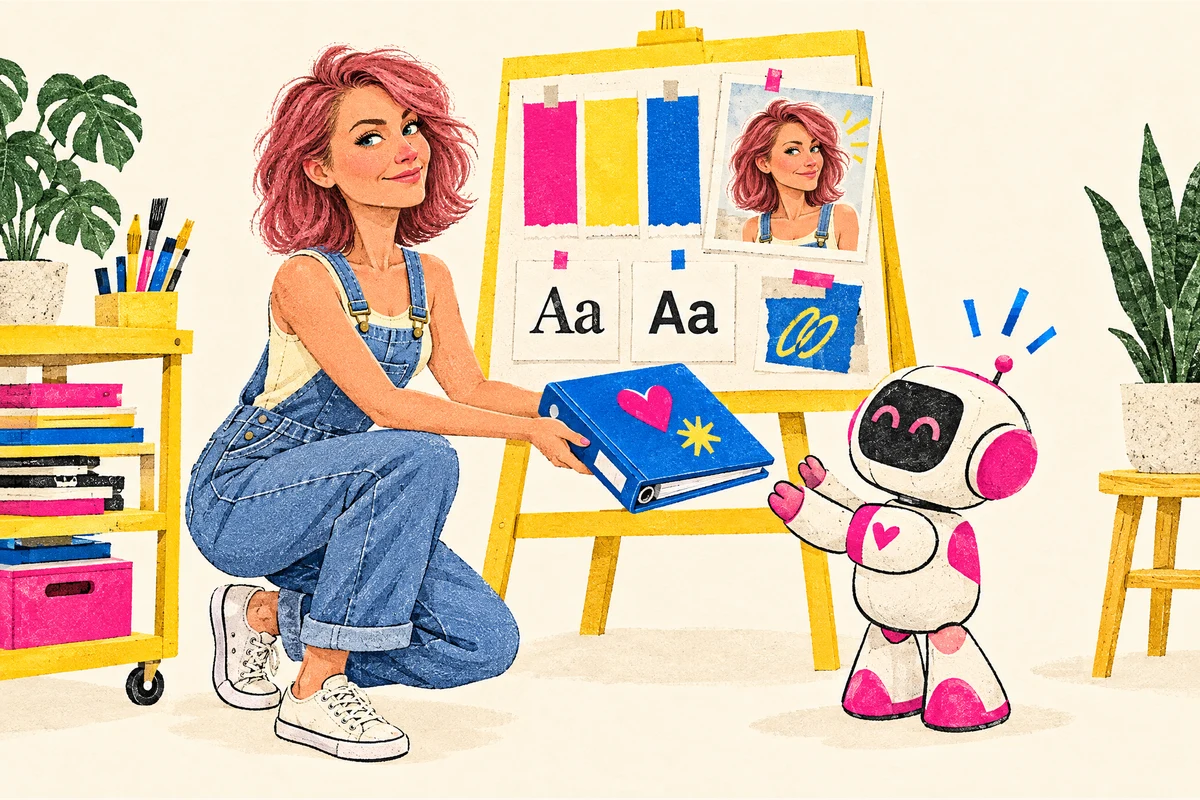
If you've typed “make it sound like me” more than twice, you need a brand note: one short note you paste in, so you stop explaining yourself every time.
Who it's for
Anyone who asks AI for help with posts, emails, texts to customers, listings or flyers, and keeps rewriting what comes back. It works just as well for a bakery, a salon, a class you teach, a dog-walking service or a community group as for something online.
Use it when
- You keep typing “make it sound like me”, “less salesy” or “shorter” in every chat.
- You run a bakery, a salon, a class or a market stall and want help with captions, flyers or texts to customers that still sound like you.
- What AI writes for you sounds fine, but like everyone else, so you end up rewriting most of it.
- Someone else helps with your posts now and then, and you want them, and Claude, to get your tone right the first time.
You'll get: A short brand note you can paste into any chat (who you help, how you sound, what you'd never say and the facts it can use), plus one test piece written with it.
How to do it
Collect three things you've written that sound like you
Look through your sent texts, captions, emails to customers, a flyer or the sign on your counter. Copy three into one note. Under each, write one line on why it sounds like you. If you always use certain colors, a font or a photo style, add those too.
A baker (made up)“Cake's boxed and ready, pick it up any time after 10. Candles are on me.” Why it's me: short, friendly, one useful detail.
What good looks like: Real things you sent to real people, recently, in the kind of writing you do most.
Watch out for: Using the polished About page you wrote to impress, or something someone else wrote for you. If you have nothing yet, write how you'd explain what you do to a friend in a text.
Say who you're writing for and what you want them to do
Name one kind of person, and the one thing you'd like them to do after reading: order, book, come along or reply.
A dog groomer (made up)Busy dog owners nearby who want a groom before a trip. They should text to book a slot.
What good looks like: You can picture a real customer reading it.
Watch out for: “Everyone” or “small businesses”. Writing for everyone is how you end up sounding like everyone.
Write your never list
List the words, the tone and the promises that make you wince when AI or a competitor uses them.
A yoga teacher (made up)Never: “transform your life”, “journey”, guilt about skipping class, more than one emoji.
What good looks like: Real words you've seen and disliked, not general wishes like “not cheesy”.
Watch out for: Only listing what you like. The never list is what saves you the most rewriting.
Split the facts from what AI must not make up
Write down what's true and decided: what you offer, what's included, the price, times, where, how to order. Then add a line, “Not decided yet: ask me”, for anything you haven't settled.
What good looks like: Claude can use every fact on the list, and asks you instead of guessing the rest.
Watch out for: Leaving the facts out. That's when AI fills the gap with a made-up price, “only 3 spots left” or a review nobody wrote.
Test it on one real thing
Start a new chat, paste your note and ask for something you write often: a post, a text to a customer, a listing or a flyer line. Read it out loud. Where it sounds off, work out which rule was missing and add it.
What good looks like: You'd send it with a few small edits, and you know why each edit was needed.
Watch out for: Rewriting the whole note because of one bad sentence. Fix or add one rule at a time.
Save it where you'll find it, and paste it in every time
Keep the note in your phone's notes app with a clear name, like “My brand note”. Paste it at the top of any new chat where Claude writes for you. Add the date when you change it.
What good looks like: One short, current note you can find in five seconds.
Watch out for: Counting on Claude to remember it in every new chat. Paste it in, so you know it's there.
Do it with Claude in 10 minutes
This prompt does steps 1 to 5 in about 10 minutes. Claude asks a few quick questions, one at a time, then gives you a short brand note and tries it on something you write often. It helps to have one or two things you've written ready to paste, but you can start without them.
Write my brand note
Turn how you really write into a short note Claude can follow, then test it on one small thing. Paste it into Claude and answer its few quick questions. The result comes back in the same chat.
Read the prompt + an example
I want a short brand note I can paste at the start of any chat, so what you write for me sounds like me and doesn't make things up. My business might be a physical product, a service, a class, an event, a local shop or something digital. Help me build the note from how I really write, then test it on one small thing.

Find out these things. Each has a purpose. I may not be able to answer the direct version, so start with easier, concrete questions that get to the same place:
- what I offer and who it's for, in plain words (purpose: so everything is written for one kind of person; try “who was the last person who bought, booked or asked about it?”)
- one to three real things I've written that sound like me, like a text to a customer, a caption, an email, a flyer or a sign (purpose: the evidence for how I sound; ask me to paste them, or type one from memory. If I have none, write two short versions of the same message in different tones and let me pick, or ask how I'd explain what I do to a friend in a text)
- words, tone or promises I never want (purpose: the never list saves the most rewriting; try “what has AI or a competitor written that made you wince?” with choices like salesy, too formal, too many emoji)
- the facts you may use, like what's included, price, times, place and how to order, and anything I haven't decided yet (purpose: so you never fill a gap with a made-up price, review or promise; anything I'm unsure of is “not decided”)
- what I write most often (purpose: for the test at the end; offer choices like a social post, a text or email to a customer, a listing or a flyer)

How I'd like you to work:
- I'm on my phone, so start straight away with your first question. No introduction.
- Ask one short question at a time and wait for my answer. Say in a few words why you're asking.
- Start with the easier, concrete version of each question.
- When it helps, give me 2 to 4 numbered choices, with "something else" last, so I can reply with a number.
- If an answer is vague, ask for one real example instead of guessing. Use what I've already told you. If I paste a lot at once, use it and skip those questions.
- Stop once you have enough. That's usually three to five questions. If I say "just do it", make your best guess and tell me what you assumed.
- Write for a phone screen: plain words, short lines, no tables, no jargon.

When you have enough, give me:
- My brand note, under 200 words, ready to paste into any chat, in these parts: Who I help and what I offer. How I sound: 3 to 5 rules, each with a few words quoted from my examples that show it. Never: words, tone and promises to avoid. Facts you can use. Not decided (ask me): anything I haven't confirmed. Looks: colors, fonts or photo style, only if I gave them.
- Then one test: the thing I write most often, written with the note, about something real I mentioned.
- Then ask me in one line what feels off. If I tell you, add or fix one rule and show me the updated note.

Only use facts I gave you. Don't make up prices, dates, reviews, results or promises: put them under "Not decided (ask me)". Mark any rule that doesn't come from my examples as "suggested", so I can keep it or drop it. Don't copy whole lines from my examples into the test. Don't guess personal details about me.
A filled-in example
These are illustrative details. Use your own information.
I want a short brand note I can paste at the start of any chat, so what you write for me sounds like me and doesn't make things up. My business might be a physical product, a service, a class, an event, a local shop or something digital. Help me build the note from how I really write, then test it on one small thing.

Find out these things. Each has a purpose. I may not be able to answer the direct version, so start with easier, concrete questions that get to the same place:
- what I offer and who it's for, in plain words (purpose: so everything is written for one kind of person; try “who was the last person who bought, booked or asked about it?”)
- one to three real things I've written that sound like me, like a text to a customer, a caption, an email, a flyer or a sign (purpose: the evidence for how I sound; ask me to paste them, or type one from memory. If I have none, write two short versions of the same message in different tones and let me pick, or ask how I'd explain what I do to a friend in a text)
- words, tone or promises I never want (purpose: the never list saves the most rewriting; try “what has AI or a competitor written that made you wince?” with choices like salesy, too formal, too many emoji)
- the facts you may use, like what's included, price, times, place and how to order, and anything I haven't decided yet (purpose: so you never fill a gap with a made-up price, review or promise; anything I'm unsure of is “not decided”)
- what I write most often (purpose: for the test at the end; offer choices like a social post, a text or email to a customer, a listing or a flyer)

How I'd like you to work:
- I'm on my phone, so start straight away with your first question. No introduction.
- Ask one short question at a time and wait for my answer. Say in a few words why you're asking.
- Start with the easier, concrete version of each question.
- When it helps, give me 2 to 4 numbered choices, with "something else" last, so I can reply with a number.
- If an answer is vague, ask for one real example instead of guessing. Use what I've already told you. If I paste a lot at once, use it and skip those questions.
- Stop once you have enough. That's usually three to five questions. If I say "just do it", make your best guess and tell me what you assumed.
- Write for a phone screen: plain words, short lines, no tables, no jargon.

When you have enough, give me:
- My brand note, under 200 words, ready to paste into any chat, in these parts: Who I help and what I offer. How I sound: 3 to 5 rules, each with a few words quoted from my examples that show it. Never: words, tone and promises to avoid. Facts you can use. Not decided (ask me): anything I haven't confirmed. Looks: colors, fonts or photo style, only if I gave them.
- Then one test: the thing I write most often, written with the note, about something real I mentioned.
- Then ask me in one line what feels off. If I tell you, add or fix one rule and show me the updated note.

Only use facts I gave you. Don't make up prices, dates, reviews, results or promises: put them under "Not decided (ask me)". Mark any rule that doesn't come from my examples as "suggested", so I can keep it or drop it. Don't copy whole lines from my examples into the test. Don't guess personal details about me.

---
HOW IT GOES (a made-up example)
Claude: Who was the last person who ordered or asked about what you make? (So the note is written for them.)
You: A parent ordering a birthday cake for Saturday.
Claude: Paste one or two texts or captions you've sent that sound like you.
You: “Cake's boxed and ready, pick it up any time after 10. Candles are on me.”
Claude: What should it never sound like? 1. Salesy 2. Too formal 3. Too many emoji 4. Something else
You: 1, and never say “artisanal”
…two more short questions, then a brand note and a test text to a customer about Saturday pick-up.
Download the original prompt (.txt)
See it in action
Molly teaches Claude her own brand. Re-created from the brand rules and lines she already uses on this site; the test post is Claude's draft.
Who was the last person who signed up for or asked about what you offer? (So the note is written for them.)
Someone with a full-time job they're good at, who wants something of their own but doesn't know where to start.
Paste one or two things you've written that sound like you. (They show me how you sound better than adjectives.)
“You're good at what you do. I'll help you with everything else.” And: “You bring what you know. I handle the tech.”
What should it never sound like? 1. Salesy or hyped 2. Techy 3. Hustle and grind 4. Something else
All three. Never call it coaching, and no “ship”, “MVP” or “scope”.
Which facts can I use? (So I don't make any up.)
The Ready to Sell Challenge: 14 days, 20 minutes a day, mostly from your phone, with Claude.
Your brand note. Who: people with a full-time job they're good at who want something of their own. How you sound: short, plain and supportive (“I'll help you with everything else”), with one practical next step. Never: hype, tech words like “ship” or “MVP”, hustle, “coaching”. Facts: the Ready to Sell Challenge, 14 days, 20 minutes a day, mostly from your phone. Not decided: ask me. Test post: “Good at your job but stuck on your own idea? Ready to Sell is 14 days, 20 minutes a day, mostly from your phone. You keep doing what you're good at. I'll take care of the tech side.”
What to do next
Save the note in your phone's notes app as “My brand note”. Next time you ask Claude to write something, paste it in first. Each time something sounds off, add one rule. After a few rounds, the note does the explaining for you.
Your answer stays in your Claude chat. To find it faster, screenshot it or copy it into your notes.
WHEN YOU WANT HELP WITH THE NEXT STEP
Want to turn your know-how into something people can buy?
Make your first small digital product and launch it with Molly, one step a day.
December 1–14. Daily videos, three office hours, a private group, and feedback from Molly.
Join the waitlistDoors open Nov 24 for one week. The waitlist gets $47 for the first 48 hours (then $97), and keeps 40+ of my AI agents after the challenge.