A FREE PRACTICAL GUIDE · BY MOLLY
Make Yourself a Tiny Coworker
Plan a little character of you, or a mascot, with three real jobs, then make the first one this week.
Let’s try one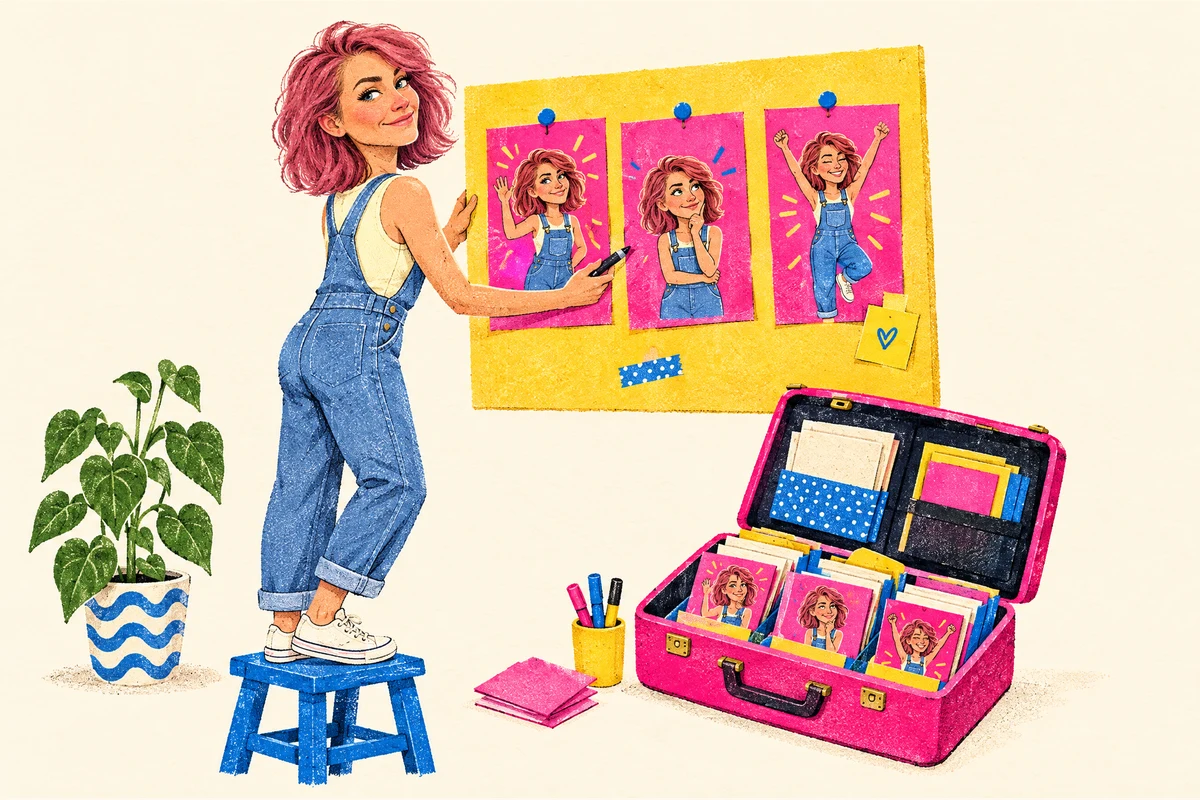
A little character who looks like you, or like your dog, can point to the next step, spot a mistake and cheer when something's done, so you don't have to be on camera every time.
Who it's for
Anyone who shares their work with people: posts, flyers, a market-stall sign, a class handout, texts to customers or a free guide. You want something friendly that people recognize, without being on camera every time. It can be a drawing of you, a cut-out photo of you, or a mascot like your dog or a loaf of bread.
Use it when
- You post or hand things out often and don't want your face on camera every time.
- You want a friendly way to point people to the next step: book here, bring this, watch out for that.
- You run a bakery stall, a yoga class or a grooming shop, and want something on your signs, cards and texts that people remember.
- You've asked an AI for a cartoon of yourself and got a different person every time.
You'll get: A plan for your tiny coworker: a name, three jobs with the words to go next to each, a keep-it-the-same list, and how to make the first one this week, with or without AI.
How to do it
Pick the one place it shows up first
Where do people see your work most? Your Instagram posts, a flyer on the café board, the card in your pastry case, a class handout, the text you send when a dog is ready for pickup. Start with one.
What good looks like: One real place you'll use it this month.
Watch out for: Planning it for everything at once: the logo, the website, the van, the T-shirts.
Give it three jobs
Think of three moments for your customer: when they're not sure what to do, when they might get something wrong, and when they've done it. Your coworker helps at each one: it points to the next step, holds up the thing to check, or cheers. For each, write what it's doing, what it's holding and the short line that goes next to it.
A dog groomer (made up)Holds a leash: “Book the next trim.” Holds up a brush, one eyebrow raised: “Brush twice a week.” Cheers next to a fluffy dog: “All done, ready at 3.”
MollyThe little cartoon Mollys on this site, like the one at the top, play her team of AI agents in her Instagram posts: a detective, an inspector, one on the phone.
What good looks like: Each job helps with something right next to it.
Watch out for: A character that only decorates. If you could delete it and nothing is lost, it doesn't have a job yet.
Choose how you'll make it
Pick the way you can do this week. A cut-out photo: take three photos of yourself, or your mascot, doing the three jobs against a plain wall, then cut yourself out (on an iPhone, press and hold on yourself in the photo; many Android phones and free apps can do the same). A drawing: yours, a friend's, or a local artist you pay. Or an image tool that works from your photos: ask Claude to suggest one, and check what it does with your photos before you upload any.
A yoga teacher (made up)Three photos on a phone against the studio wall, cut out and put on the class flyer and the reminder text.
A baker (made up)A doodle of themself holding a whisk, drawn once on paper and photographed for the pastry-case cards.
What good looks like: Something you can finish this week with what you already have.
Watch out for: Waiting until you can pay an illustrator, or spending an evening on AI pictures that each look like someone else.
Write down what stays the same
One outfit, one prop that says what you do (a whisk, a yoga mat, a brush), two or three colors, and one style. Save it in your notes as your keep-it-the-same list. Every new pose starts from it.
What good looks like: Someone who saw one would recognize the next.
Watch out for: Changing the outfit, the hair or the style every time. That's a whole cast, not a coworker.
Make one, check it, then make the rest
Make the first job's picture. Look at it at the size people will see it: on your phone screen, or from across the room for a flyer or sign. Put the words next to it as normal text, not inside the picture, so you can change them. When it looks like the same character to you, make the other two from the same photo, drawing or description.
What good looks like: Three pictures, side by side, that look like the same character doing three different things.
Watch out for: Making ten before checking one. If the first one is off, all ten will be.
Do it with Claude in 10 minutes
This prompt does the planning in about 10 minutes. Claude asks a few quick questions, one at a time, then gives you a name, three jobs, your keep-it-the-same list and how to make the first one this week. Making the pictures comes after.
Plan my tiny coworker
Plan a little character with three real jobs and a look that stays the same. Paste it into Claude and answer its few quick questions. The result comes back in the same chat.
Read the prompt + an example
I want a tiny coworker: a small character based on me (a drawing, a cartoon or a cut-out photo of me), or a mascot like my pet or my product, that I can reuse on my posts, flyers, signs, handouts, texts or pages. My work could be a physical product, a service, a class, an event, a local business or something digital. Help me plan it so it has real jobs and looks like the same character every time.

Find out these things. Each has a purpose. I may not be able to answer the direct version, so start with easier, concrete questions that get to the same place:
- what I make, sell, teach or run, and the one place the character will show up first (purpose: so its jobs fit real moments; try “where do people see your work most: posts, flyers, a sign, texts or a page?”)
- the moments where my customers get stuck, get something wrong or are happy (purpose: each one becomes a job; try “what do people ask you right before they buy or book?” or “what do they get wrong afterwards?”)
- how I'd like to make it: a cut-out photo of me, a drawing by me or someone I know, a mascot (like my pet or product, photographed and cut out), or an image tool working from my photos (purpose: something I can actually do this week; if I'm not sure, recommend one)
- the look: what I usually wear, one prop that says what I do, two or three colors, and anything I don't want shown (purpose: what stays the same so people recognize it; try “what are you usually wearing or holding when you work?”)

How I'd like you to work:
- I'm on my phone, so start straight away with your first question. No introduction.
- Ask one short question at a time and wait for my answer. Say in a few words why you're asking.
- Start with the easier, concrete version of each question.
- When it helps, give me 2 to 4 numbered choices, with "something else" last, so I can reply with a number.
- If an answer is vague, ask for one real example instead of guessing. Use what I've already told you, and skip anything you can work out.
- Stop once you have enough. That's usually three to five questions. If I already know where it goes or what its jobs are, build on that and skip those questions. If I say "just do it", make your best guess and tell me what you assumed.
- Write for a phone screen: plain words, short lines, no tables, no jargon.

When you have enough, give me:
- A name for my tiny coworker and one line on who it is.
- Three jobs, each tied to a real moment for my customers: where it appears, what it's doing, what it's holding, and a short line of words to put next to it.
- A "keep it the same" list: outfit, prop, colors and style, short enough to save in my notes.
- How to make the first one this week, the way I picked, in 3 to 5 short steps. For a cut-out photo: the three photos to take and how to stand. For a drawing: what to draw first. For an image tool: name one or two to try, then one description I can copy and paste there along with my photos.
- How to check it: at the size people will see it (on a phone, or from across the room for a flyer or sign), and all three side by side.

Don't try to make the picture yourself: give me the plan and the words. Don't make up how I look; ask, or leave a gap for me to fill. Keep words, prices and dates out of the picture itself, next to it as normal text, so I can change them. Nothing that copies someone else's character or brand. Keep it small enough to make the first one next week.
A filled-in example
These are illustrative details. Use your own information.
I want a tiny coworker: a small character based on me (a drawing, a cartoon or a cut-out photo of me), or a mascot like my pet or my product, that I can reuse on my posts, flyers, signs, handouts, texts or pages. My work could be a physical product, a service, a class, an event, a local business or something digital. Help me plan it so it has real jobs and looks like the same character every time.

Find out these things. Each has a purpose. I may not be able to answer the direct version, so start with easier, concrete questions that get to the same place:
- what I make, sell, teach or run, and the one place the character will show up first (purpose: so its jobs fit real moments; try “where do people see your work most: posts, flyers, a sign, texts or a page?”)
- the moments where my customers get stuck, get something wrong or are happy (purpose: each one becomes a job; try “what do people ask you right before they buy or book?” or “what do they get wrong afterwards?”)
- how I'd like to make it: a cut-out photo of me, a drawing by me or someone I know, a mascot (like my pet or product, photographed and cut out), or an image tool working from my photos (purpose: something I can actually do this week; if I'm not sure, recommend one)
- the look: what I usually wear, one prop that says what I do, two or three colors, and anything I don't want shown (purpose: what stays the same so people recognize it; try “what are you usually wearing or holding when you work?”)

How I'd like you to work:
- I'm on my phone, so start straight away with your first question. No introduction.
- Ask one short question at a time and wait for my answer. Say in a few words why you're asking.
- Start with the easier, concrete version of each question.
- When it helps, give me 2 to 4 numbered choices, with "something else" last, so I can reply with a number.
- If an answer is vague, ask for one real example instead of guessing. Use what I've already told you, and skip anything you can work out.
- Stop once you have enough. That's usually three to five questions. If I already know where it goes or what its jobs are, build on that and skip those questions. If I say "just do it", make your best guess and tell me what you assumed.
- Write for a phone screen: plain words, short lines, no tables, no jargon.

When you have enough, give me:
- A name for my tiny coworker and one line on who it is.
- Three jobs, each tied to a real moment for my customers: where it appears, what it's doing, what it's holding, and a short line of words to put next to it.
- A "keep it the same" list: outfit, prop, colors and style, short enough to save in my notes.
- How to make the first one this week, the way I picked, in 3 to 5 short steps. For a cut-out photo: the three photos to take and how to stand. For a drawing: what to draw first. For an image tool: name one or two to try, then one description I can copy and paste there along with my photos.
- How to check it: at the size people will see it (on a phone, or from across the room for a flyer or sign), and all three side by side.

Don't try to make the picture yourself: give me the plan and the words. Don't make up how I look; ask, or leave a gap for me to fill. Keep words, prices and dates out of the picture itself, next to it as normal text, so I can change them. Nothing that copies someone else's character or brand. Keep it small enough to make the first one next week.

---
HOW IT GOES (a made-up example)
Claude: What do you make or run, and where do people see it most? (So the jobs fit real moments.) 1. Posts 2. Flyers or signs 3. Texts to customers 4. Something else
You: 3, I groom dogs from my garage
Claude: What do owners ask before they book, or get wrong afterwards? (Each one can become a job.)
You: When's the next trim. And they never brush between visits.
…two more short questions, then: “Tiny you” in your green apron with a brush. Job 1: holding a leash next to the booking text, “Next trim in 6 weeks? Reply with a day.” Job 2: brush up, eyebrow raised, “Brush twice a week.” Job 3: cheering by a fluffy dog in the pickup text, “All done, ready at 3.”
Download the original prompt (.txt)
See it in action
A dog groomer plans a tiny coworker. A made-up example, from someone who'd never made a picture with AI.
What do you make or run, and where do people see it most? (So the jobs fit real moments.) 1. Posts 2. Flyers or signs 3. Texts to customers 4. Something else
3. I groom dogs from my garage. And a sign in the window.
What do owners ask right before they book, or get wrong afterwards? (Each one can become a job.)
When's the next trim. And they never brush between visits.
How would you like to make it? 1. A cut-out photo of you 2. A drawing 3. A mascot, like a dog 4. Something else
1, with my dog Pepper.
What are you usually wearing or holding when you work? (That's what stays the same.)
Green apron and a slicker brush.
Meet Tiny You and Pepper. Job 1, booking text: you holding Pepper's leash. “Next trim in 6 weeks? Reply with a day.” Job 2, window sign: brush up, one eyebrow raised. “Brush twice a week.” Job 3, pickup text: cheering next to a fluffy dog. “All done, ready at 3.” Keep the same: green apron, the brush, Pepper, plain background. This week: three photos against your garage wall, one per job. Then press and hold on yourself in each photo to cut it out.
What to do next
Make the first job's picture this week and put it in the one place you picked. Then make the other two from the same one. If one doesn't look right, tell the same Claude chat what's off and ask what to change.
Your answer stays in your Claude chat. To find it faster, screenshot it or copy it into your notes.
WHEN YOU WANT HELP WITH THE NEXT STEP
Want to turn your know-how into something people can buy?
Make your first small digital product and launch it with Molly, one step a day.
December 1–14. Daily videos, three office hours, a private group, and feedback from Molly.
Join the waitlistDoors open Nov 24 for one week. The waitlist gets $47 for the first 48 hours (then $97), and keeps 40+ of my AI agents after the challenge.