
The Vasa Problem
Why brilliant strategies sink in the harbor, and what the Swedish navy spent 333 years proving.
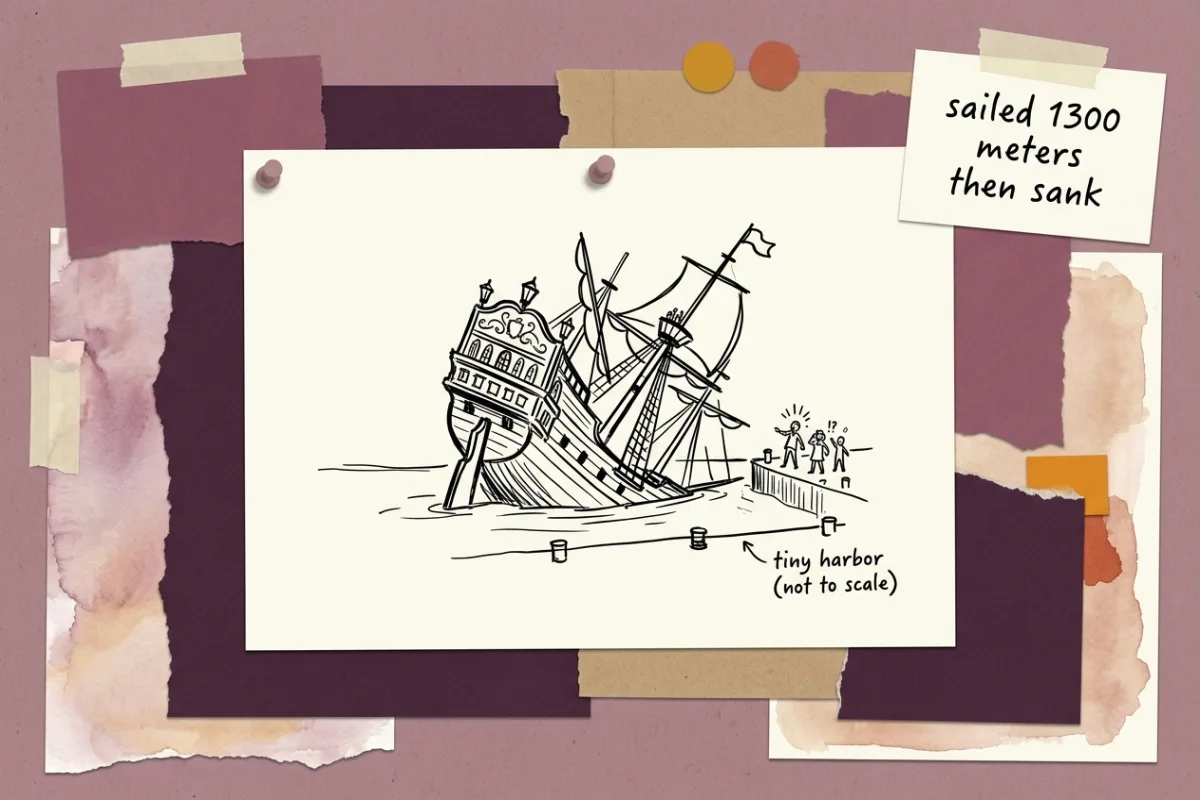
On August 10, 1628, the most powerful warship Sweden had ever built sailed 1,300 meters and sank in front of a crowd. The ship wasn't bad. The strategy was bad. Yours is the same shape.
The Vasa Problem
Why brilliant strategies sink in the harbor, and what the Swedish navy spent 333 years proving.
You have a strategy.
It's good. You've thought about it. The Notion doc has been refined six times. Your team has heard a version of it at the last three offsites. You can describe it in two paragraphs without having to look. The diagrams are clean. The roadmap maps to the strategy. The metrics map to the roadmap.
The strategy is not the problem.
The problem is that you are, right now, building a 17th-century Swedish warship. You have ordered the second tier of cannons. The hull is not rated for them. Nobody on the project has the authority, or the inclination, to walk into your office and say "this is going to capsize." So you are sailing into the harbor on a ship that has already failed. You just haven't pushed off from shore yet.
Most strategies don't fail. They drown.
What happened on August 10, 1628
On the morning of August 10, 1628, the warship Vasa launched from Stockholm harbor on her maiden voyage. King Gustavus Adolphus had personally specified her design. She was 226 feet long, carried 64 bronze cannons across two gun decks, and had been built over three years by 400 men using the timber of around 1,000 oak trees.
She was the most expensive military project in Swedish history.
She sailed 1,300 meters.
A light gust caught the sails. The ship heeled to port. Water poured in through the open gun ports on the lower deck. Within minutes the Vasa was on the bottom of the harbor, in 32 meters of water, in plain view of the people who had come to cheer her departure. Thirty crew members died.
The Vasa stayed there for 333 years.
In 1956 a Swedish marine archaeologist named Anders Franzén found her. The Baltic's low salinity had preserved 95% of the original wood. They raised her in 1961. Today she sits in the Vasa Museum in Stockholm, as the most studied case of execution failure in pre-industrial history.
The reason she sank wasn't a mystery, then or now. The hull was too narrow for two gun decks. Everyone on the project knew it. Some had measured it. The shipwright had explicitly told the king's lieutenant. A stability test on the dock, one week before the launch, had shown the ship rolling dangerously when 30 sailors ran from one rail to the other. The test was stopped before the ship capsized at the pier.
The launch went ahead anyway. Because the strategy had been set, and the king was waiting, and nobody had the authority to delay.
You are not failing because your strategy is wrong. You are failing because your strategy doesn't have a system underneath it that can absorb a "no."
What Donald Sull found in 2015
In March of 2015, three researchers — Donald Sull at MIT, Rebecca Homkes at London Business School, and Charles Sull — published a piece in the Harvard Business Review titled "Why Strategy Execution Unravels and What to Do About It." The article was the synthesis of nine years of research across more than 250 companies and 8,000 surveyed managers.
The headline finding ran against most of what was being written about execution at the time.
The big problem was not commitment. Most managers were committed to the strategy. The big problem was not capability. Most teams had the skills. The big problem was not even alignment with senior leadership. Most teams understood what the leadership wanted.
The big problem was coordination across teams that had to work together.
Vertical alignment — your team understanding what the executive wants — was strong. Horizontal alignment — your team being able to coordinate with the other three teams who had to ship something compatible — was where everything broke. 84% of managers said their teams could rely on their own boss. Only 9% said they could rely on the other team's commitments to their face.
The strategy didn't fail in the boardroom. It failed in the seam between the boardroom and the shop floor, where coordination had to happen and the system to support it didn't exist.
That's the second-tier-cannons problem. Everyone in the Swedish navy knew the hull was too narrow. The strategy was set above their heads. The system that would have allowed the news to travel back upstream didn't exist. So the news didn't travel. The ship sailed. The strategy drowned.
You have the same gap on your project. The strategy is set. The team can't push back on it. So they ship the ship.

What Kahneman and Tversky proved in 1979
In 1979 Daniel Kahneman and Amos Tversky published a paper titled "Intuitive Prediction: Biases and Corrective Procedures." It introduced the term that would become standard in every product team's vocabulary 40 years later. The planning fallacy.
Their finding, replicated dozens of times since, is that humans systematically underestimate how long their own projects will take. Even when those same humans correctly estimate how long similar projects took for other people. When asked "how long will this take," your brain runs a different calculation than when asked "how long has this taken everyone else who has tried this." The first calculation is optimistic. The second one is realistic. The first one is the one we use for ourselves.
This is why your "I'll knock this out in three weekends" never closes in three weekends. The problem isn't that you're an outlier. The problem is that your brain is doing what every human brain does, which is to apply a different and more flattering estimate to its own work than to anyone else's.
Apply this to the Vasa. King Gustavus knew that bigger ships took longer. He had data. He had records. The estimate he applied to the Vasa was not the estimate he would have applied to a competitor's project. He applied the brain's "this is mine, I will move faster" discount. The shipwrights compounded the same bias. The political layer did too.
Your strategy doc has the same bias baked in, three layers deep. The dates are wrong. The dependencies are missing. The coordination cost has been estimated at zero. You are not malicious. You're just human. Which is why the system you build has to absorb the bias, not assume it away.
What it takes to not build a Vasa
You need three layers of structure that let bad news travel back upstream while there's still time to do something about it.
1. A pre-mortem before the launch date is set. The pre-mortem is a Gary Klein technique, popularized by Kahneman in Thinking, Fast and Slow. Before you commit to the date, you sit with your team and ask: it is six months from now, the project failed catastrophically, what happened? People will tell you. They've been waiting for permission to tell you. That's the news that has to travel upstream. The pre-mortem is the structural channel for it.
2. A weekly horizontal-alignment review. Sull's research is unambiguous. The seam between teams is where strategy dies. Run a 30-minute weekly with the leads of every team that has to ship something compatible. The agenda is one question. "What did you tell us last week that turned out not to be true." If nothing has, the meeting ends. If something has, you reset the dependency that week, before the gap compounds. Most senior operators have never run this meeting. Once they do, they don't stop.
3. A scope guillotine the week before launch. This one is the hardest because it's the one with political cost. The week before launch, the question is not "what else can we add." The question is "what can we cut to ship a smaller, more stable version on the date we promised." A 32-cannon Vasa, on the date, in the water, beats a 64-cannon Vasa, two months late, on the bottom of the harbor. Always.
If you want help running those three with a real outside voice in the room, that's exactly what a Build Audit is.

The reframe
Your strategy isn't sinking because it's a bad strategy.
It's sinking because the structure underneath it has no way to push back when the strategy is wrong, and the planning fallacy guarantees that the strategy will be wrong in at least one important way that nobody has yet flagged.
You're not building a bad ship. You're building a good ship in a system that doesn't know how to tell you it can't carry the cannons.
Run the pre-mortem. Run the horizontal-alignment review. Cut the cannons.
Or sail in front of a crowd, on a Tuesday in August, and find out the hard way.
More for The Burnout Cycler
 9 min read
Burnout Is a Systems Diagnosis
Burnout isn't a character flaw. It's the receipt for an operating system that demanded heroics every day.
 8 min read
Systems Beat Self-Loathing
The 2am self-blame spiral isn't a character flaw. It's the receipt for a system you never built.
 10 min read
Decision Debt Is Why You're Tired
The cognitive cost of every "let me think about that."
Get one email a week.
A 5-minute read on shipping faster, thinking clearer, and actually finishing what you start. Free.
One a week, give or take. Unsubscribe in one click.
Ready to actually ship?
Reading these essays is the warm-up. Book a free Build Partner call and let's get your project moving.
Request a Free Build Partner Call