
The Scope Guillotine
Find the lethal minimum. Cut to it. Ship. Repeat.
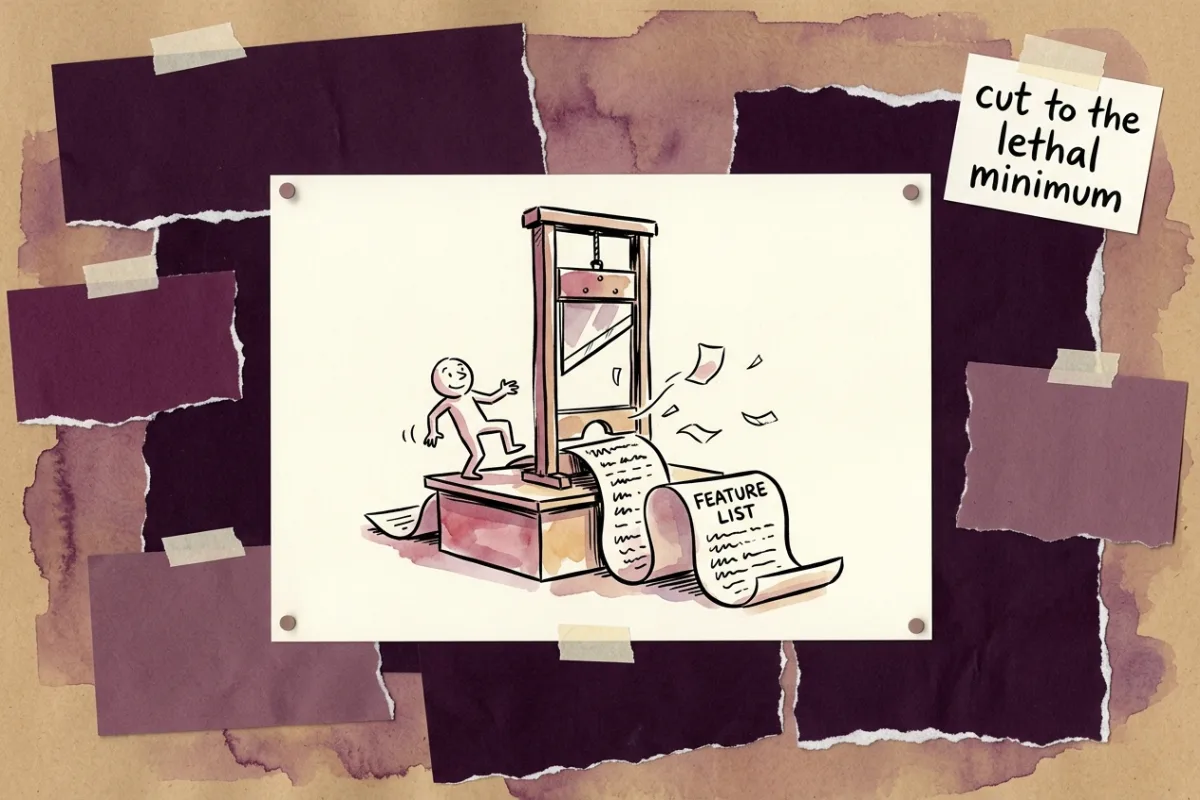
On October 7, 1903, Samuel Langley's Aerodrome sank in the Potomac. Nine days after his second failure, two bicycle mechanics with $1,000 of their own money flew. The difference wasn't budget. The difference was a blade.
The Scope Guillotine
Find the lethal minimum. Cut to it. Ship. Repeat.
You have a project that's six weeks behind.
It's not behind because you're lazy. It's behind because the scope you signed up for was bigger than the scope you can actually ship in the time you have, and every week the scope has been quietly creeping outward while you tried to grind through it. The Notion doc has 28 features now. It started with 12. The launch date has slipped three times. You're still adding things.
The thing you've been telling yourself is that the scope is non-negotiable, because every feature was added for a real reason, by a real stakeholder, and cutting any of them would compromise the product.
Wrong.
The scope is the most negotiable thing in your operation. The reason it doesn't feel that way is that nobody on your team is empowered to swing the blade, and you, the only person who is, are using your authority to add instead of to subtract.
In 1903, two men in Dayton, Ohio, settled the same argument with $1,000 and a stopwatch. The story has been told a thousand times. The version that gets told is usually wrong.
What Samuel Langley actually built
In 1903 the most-funded aviation project in the world was Samuel Pierpont Langley's. Langley was the Secretary of the Smithsonian, a respected astrophysicist, and the recipient of a $50,000 grant from the U.S. War Department, equivalent to roughly $1.7 million today. He had a team of engineers. He had access to the best machine shops in Washington. He had political backing all the way to the White House.
He built a flying machine called the Aerodrome. It was technically sophisticated. It used a 52-horsepower internal combustion engine that was, at the time, the most advanced lightweight engine ever built. The wings were a marvel of structural engineering. The fuel tank was custom-machined.
On October 7, 1903, Langley launched the Aerodrome from a houseboat on the Potomac River. It went up, then it went down, into the river, in a manner that the New York Times the next day described as "like a handful of mortar."
He tried again on December 8. Same result. The Aerodrome dropped into the Potomac, breaking the framing as it fell. Langley's career did not recover.
Two of the things that made the Aerodrome impressive — its size, its weight — were also two of the things that made it not fly. Langley had built for capability, not for flight. The blade had not been swung. The thing was too much.
What the Wright Brothers actually built
Nine days after Langley's December failure, on December 17, 1903, Wilbur and Orville Wright took off from a beach near Kitty Hawk, North Carolina. The first flight lasted 12 seconds and covered 120 feet. The fourth and final flight of the day lasted 59 seconds and covered 852 feet.
The total budget for the Wright Flyer was approximately $1,000 of the brothers' own money, much of it earned from their bicycle shop. They had no government grant, no university affiliation, and no engineering team beyond the two of them and the help of their mechanic, Charlie Taylor, who built the engine.
David McCullough's 2015 book The Wright Brothers documents in detail what the brothers actually did and didn't do. They didn't build the most powerful engine. They built the lightest one that would do the job. They didn't build the prettiest airframe. They built one that wouldn't snap in a 30-mph wind. They didn't build a passenger seat or landing gear. They built skids, because skids worked.
Most importantly, they iterated. They built and crashed three gliders before they ever attempted powered flight. Each crash was the cheapest possible test of the smallest possible question. Can the wings produce lift. Can the pilot control roll. Can the rudder move the nose. They crashed cheap and learned fast and then, when they finally added the engine, they did it on top of two years of cleanly-tested assumptions.
The Wright Brothers didn't beat Langley because they were smarter. They beat Langley because their budget forced them to cut. Every gram had to earn its place. Every feature had to justify its weight. The blade was their only competitive advantage and they swung it constantly.
The Aerodrome was the more impressive object. The Wright Flyer was the one that flew.

What Saint-Exupéry named in 1939
In 1939 a French aviator and writer named Antoine de Saint-Exupéry — best known later for The Little Prince — published a memoir called Wind, Sand and Stars, about his years flying mail routes across the Sahara. The book is mostly about flying. The single most-quoted sentence in it is about design.
"Perfection is finally attained, not when there is no longer anything to add, but when there is no longer anything to take away."
Saint-Exupéry was writing about airplane design specifically. He had spent ten years flying primitive single-engine planes across deserts where every redundant pound of weight was a real hazard. He had watched friends die in mechanically-overcomplicated planes. The simpler planes were more reliable, easier to repair, and required less fuel. The simpler planes also tended to be the ones that got home.
The line generalizes outside of aviation. It's been applied to typography, to writing, to product design, to code. The reason it generalizes is that the underlying principle is universal. Every additional element in a system adds at least three costs. The cost of building it. The cost of maintaining it. The cost of any failure mode it introduces. Most operators see only the first cost when they're adding. The second and third costs show up later, on a different ledger, billed in slow installments forever.
Saint-Exupéry's claim, repeated for forty years until his death over the Mediterranean in 1944, was that the discipline of cutting is the actual design work. Adding is the easy part. Subtracting is what separates the planes that flew home from the ones that didn't.
Your project right now has 28 features. The Wright Flyer had three.
What Ryan Singer formalized in 2019
In 2019 a designer named Ryan Singer, then at Basecamp, published a book called Shape Up: Stop Running in Circles and Ship Work that Matters. The book is free online. It is the most useful product-development manual published in the last decade.
Singer's framework is built on a single rule that almost no founder has ever applied to their own project. The rule is called fixed time, variable scope.
The team has six weeks. That is the fixed input. The scope, going in, is a one-page "pitch" that describes the rough shape of the work. The pitch is intentionally vague at the edges, because the edges are where cutting happens. As the six weeks unfolds, the team continuously chooses what to cut to keep the launch on the date. The launch date does not move. The scope moves. The features that survive are the ones that fit. The features that don't fit get killed.
Singer's claim, supported by 20 years of Basecamp shipping products this way, is that fixed-scope projects almost always end up with fixed-scope problems. The scope was wrong on day one. The scope is going to be wrong on day 42. The only question is whether the team has the discipline to cut, or whether they have the discipline to let the date slip. Most teams have the second discipline because the first one feels worse. Singer argues this is exactly backwards. Slipping the date is the worse outcome, not the better one. Cutting is the actual work.
Apply this lens to your project right now.
The launch date has slipped three times. The scope has not been cut once. You have been running with infinite-time, fixed-scope discipline. That is the inverse of the Singer rule. The Wright Brothers ran the Singer rule. They would have laughed at infinite time.
Three rules to actually swing the blade
You don't fix this by adding a feature-prioritization framework. You fix it with three rules that survive your worst Tuesday.
1. Pick a launch date and lock it. Six weeks from today. Tell three people. Put it in your calendar. The date is not negotiable. Everything else is. Most senior operators have not held a launch date in over a year. The date is the rare resource. Without it, the Singer rule cannot run, and the Wright Brothers' constraint that produced the flight does not exist for you.
2. Define the lethal minimum, in writing, on one page. Lethal means the version of the project that, if a customer used it tomorrow, would do the one thing it was supposed to do. Not the polished version. Not the impressive version. The version that flies. The Wright Flyer was lethal-minimum aviation. It looked terrible. It worked. Most senior operators are building Aerodromes. Stop building Aerodromes.
3. Cut weekly, not at the end. Every Friday afternoon, look at the scope. Find the heaviest item. Ask whether the project would fly without it. If the answer is yes, cut it. The cumulative effect of seven weekly cuts is more useful than one heroic cut at the end. This is the Saint-Exupéry move, applied as a recurring meeting. Most operators try to add weekly and cut never. Reverse it.
If you want a second voice in the room while you swing the blade, that's exactly what a 6-Week Build Partnership is.

The reframe
You don't have a scope problem because the scope is fundamental.
You have a scope problem because nobody has the authority to swing the blade, and you, who do have the authority, have been using it to add instead of subtract.
Saint-Exupéry told you. Singer drilled it. The Wright Brothers proved it on a beach in 1903 with a thousand dollars and a stopwatch.
Pick the date. Define the lethal minimum. Cut every Friday until the thing fits.
The Aerodrome is the more impressive object. The Flyer is the one that flies.
Build the Flyer.

More for The Scattered Starter
 8 min read
Ideas Aren't the Work
The idea isn't the work. The translation is the work, and you keep skipping it.
 7 min read
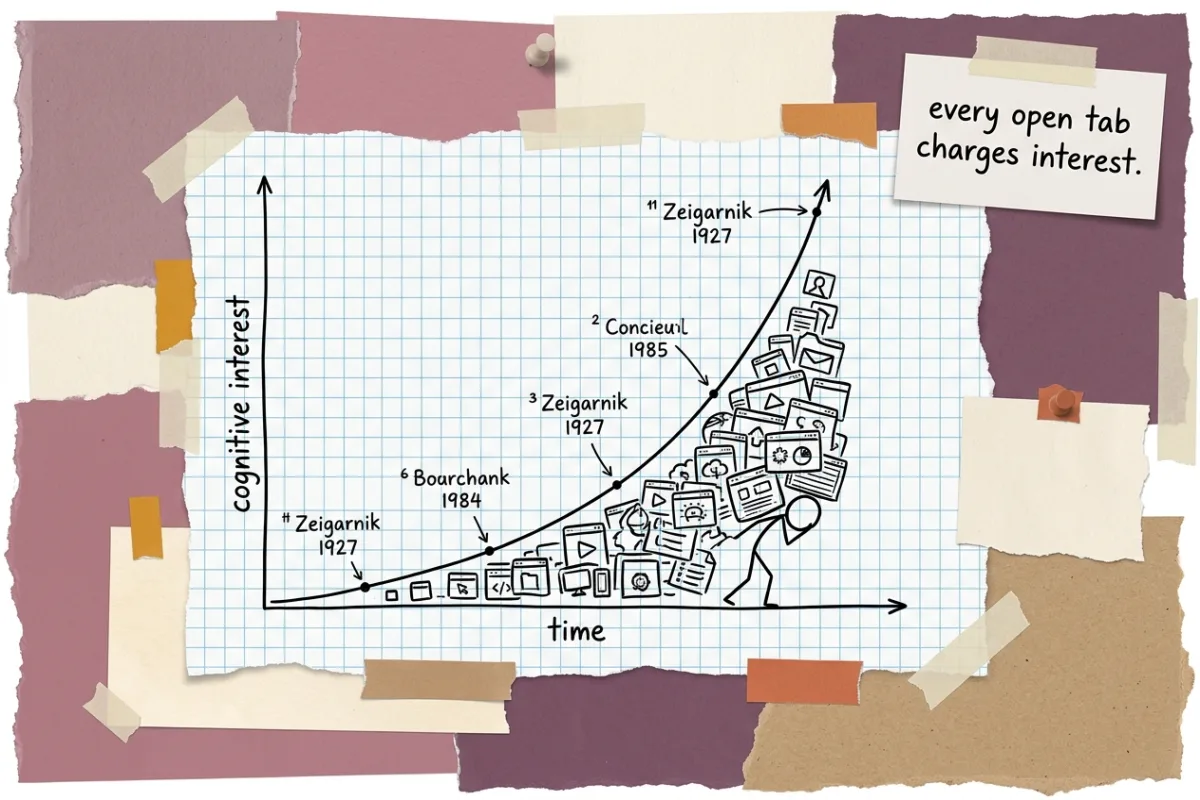
Your Potential Is a Liability
Every unfinished idea you're carrying is charging you cognitive interest, whether you've cashed it in or not.
 8 min read
Stop Dating Your Ideas
The high of starting is real. It's also the reason you've finished nothing in three years.
Get one email a week.
A 5-minute read on shipping faster, thinking clearer, and actually finishing what you start. Free.
One a week, give or take. Unsubscribe in one click.
Ready to actually ship?
Reading these essays is the warm-up. Book a free Build Partner call and let's get your project moving.
Request a Free Build Partner Call