
Your Potential Is a Liability
Every unfinished idea you're carrying is charging you cognitive interest, whether you've cashed it in or not.
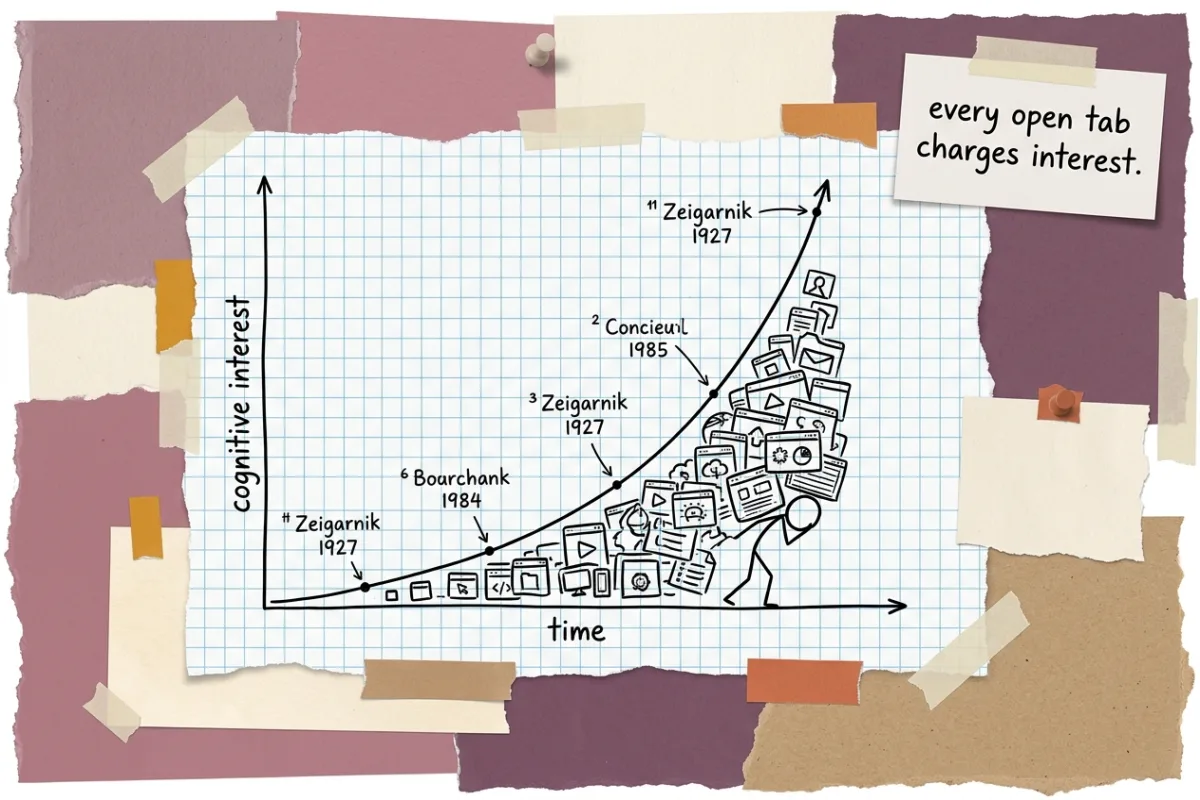
Every brilliant unfinished idea on your list is a tab open in your brain. Bluma Zeigarnik named the bug in 1927. You've been paying interest on it ever since.
Your Potential Is a Liability
Every unfinished idea you're carrying is charging you cognitive interest, whether you've cashed it in or not.
You have ideas.
You have the SaaS prototype that's 80% done in a folder called ~/projects/oldstuff/. You have the newsletter you started last March, with 38 subscribers, that you haven't sent in nine weeks. You have the course outline in Notion. You have the book proposal in Google Docs that you wrote in a weekend in 2024 and haven't opened since. You have the consultancy idea you keep talking about at dinner parties.
People who know you say you have so much potential.
It used to feel like a compliment. At 28, "potential" meant the runway was long. At 41, "potential" means a list of things you keep starting.
Each one is real. Each one could become real. Each one is real, in the only sense your brain cares about, which is that each one is open and unresolved and quietly pinging you at 2am, every night, for years.
That's not potential. That's a liability with no due date.
Bluma Zeigarnik named it in 1927
In Berlin in the late 1920s, a young Lithuanian psychologist named Bluma Zeigarnik was sitting in a café with her professor, Kurt Lewin. Lewin noticed something strange. The waiter could remember every drink ordered by every table currently open, in detail, without notes. As soon as a table paid the bill, the waiter forgot the order completely.
Zeigarnik went back to the lab and turned the observation into a study. She gave participants a series of small tasks — puzzles, problems, simple manual jobs — and interrupted them on half. Then she asked them, an hour later, what they remembered.
The interrupted tasks were remembered roughly twice as well as the completed ones.
The phenomenon now carries her name. The Zeigarnik Effect. Uncompleted tasks occupy more cognitive bandwidth than completed ones. Your brain keeps an active background process running on every open task — one process per task, indefinitely, until the task closes.
She published the result in her 1927 doctoral dissertation. The finding has been replicated by Roy Baumeister, Florence Goschke, and dozens of others in the 90+ years since. Every time, with the same shape. Open loops are heavier than closed ones.
You aren't tired because you have a lot to do.
You're tired because you have a lot open.
What Sophie Leroy proved in 2009
In 2009 a researcher named Sophie Leroy, then at NYU, published a paper in Organizational Behavior and Human Decision Processes with the most accurate title in modern psychology: "Why Is It So Hard to Do My Work?"
Leroy ran a series of experiments. She gave knowledge workers a Task A, interrupted them, and moved them to a Task B. Then she measured cognitive performance on Task B.
The performance dropped sharply. Even when subjects had been told to "focus completely on Task B." Even when 25 minutes had passed. Even when they reported feeling "fully focused."
Leroy named the phenomenon attention residue. When you switch from one task to another without finishing the first, a fragment of your attention stays with the first task. The fragment doesn't disappear. It bleeds into the new task. The new task gets the leftovers of your cognition.
Now scale that up.
You're not switching between two tasks. You're carrying eight open projects, four open decisions, three half-written drafts, and a partner project you haven't given an honest hour to in seven months. Each one is generating attention residue, all the time, in the background. The Tuesday afternoon when you're trying to focus on your real work is the Tuesday afternoon when nine other open loops are quietly billing your attention at the same time.
You're not undisciplined. You're under-resourced, by yourself, at the cognitive level.

What David Allen built around the same insight
David Allen published Getting Things Done in 2001. The book sold five million copies and became the patient zero of the modern productivity movement. Every productivity app you've ever used, from Things to Todoist to Notion templates to whatever your team uses now, is a descendant of GTD.
The premise of the system, in one sentence, is that the cognitive cost of an open commitment is paid whether or not the commitment is in your conscious working memory. Allen called these open loops. Every "I should really get back to" and "I keep meaning to" and "remind me to" is an open loop, charging interest, in the background, all day, every day.
Allen's claim was that you cannot solve this with willpower. You cannot push the loops out of consciousness. You can only do two things with an open loop. Close it, or capture it into a trusted system that closes it for you.
The capture move is the entire trick. The reason it works isn't magic. It's that your brain's "remember this" subroutine releases the loop the moment it's confident the system has it. Confident is the load-bearing word. The system has to be one you actually check, with an actual cadence, where the loop will actually get processed. Otherwise the brain doesn't release it, and the cost stays on your books.
Most senior operators have a system. They have a Notion. They have a Linear. They have a master doc with 600 line items. The system is full. The brain still doesn't trust it. So the loops stay on, despite the capture.
The fix isn't a better tool.
The fix is a regular weekly review where loops actually close, are actually scheduled, or are actually killed.
Three moves that close loops at the source
You don't fix this with another planner. You fix it by reducing the open-loop count, on purpose, on a cadence.
1. Run an open-loop audit. Open a doc. List every project, idea, half-finished thing, and "I should really" you're carrying right now. The list will be longer than you think. Most senior operators surface 30-60 of these. Naming them drops the cognitive load by half before you've decided a single one. The Zeigarnik Effect releases the moment the loop is captured to a system that has a date attached.
2. Kill 60% of the list this week. This is the move people skip. Most of those open loops are not active commitments. They're aspirational. The cost of carrying them is real. The cost of killing them is a 30-second wince. Cross them off. Move them to a separate "Maybe Forever" doc that you literally never look at. The brain releases the loop. The cost stops accruing.
3. Of the remainder, scope-lock the next 6 weeks to one. One. Not three. Not five. One. The Scope Guillotine isn't punishment. It's the only way to shrink the open-loop count, finish a thing, and prove to the system that closing loops is a thing you actually do. The 6-Week Build Partnership exists for exactly this move.
If you can't bring yourself to kill 60%, that itself is the data. The open loops aren't ideas. They're identity. You're attached to being the kind of person who might do all of them. That attachment is what's costing you. The cost just isn't itemized on any invoice you receive.
The reframe
You don't have a potential problem.
You have an open-loop problem.
Every "could" on your list is a load-bearing tab in your brain, and your brain is running out of memory because every tab is still open from 2022, and Bluma Zeigarnik told you in 1927 that this is exactly how it would feel.
You don't need more potential. You need more closed.
Pick the one project you'd actually ship. Kill the 30 things you wouldn't. Set a date.
Closed loops don't bill you anymore.

More for The Scattered Starter
 9 min read
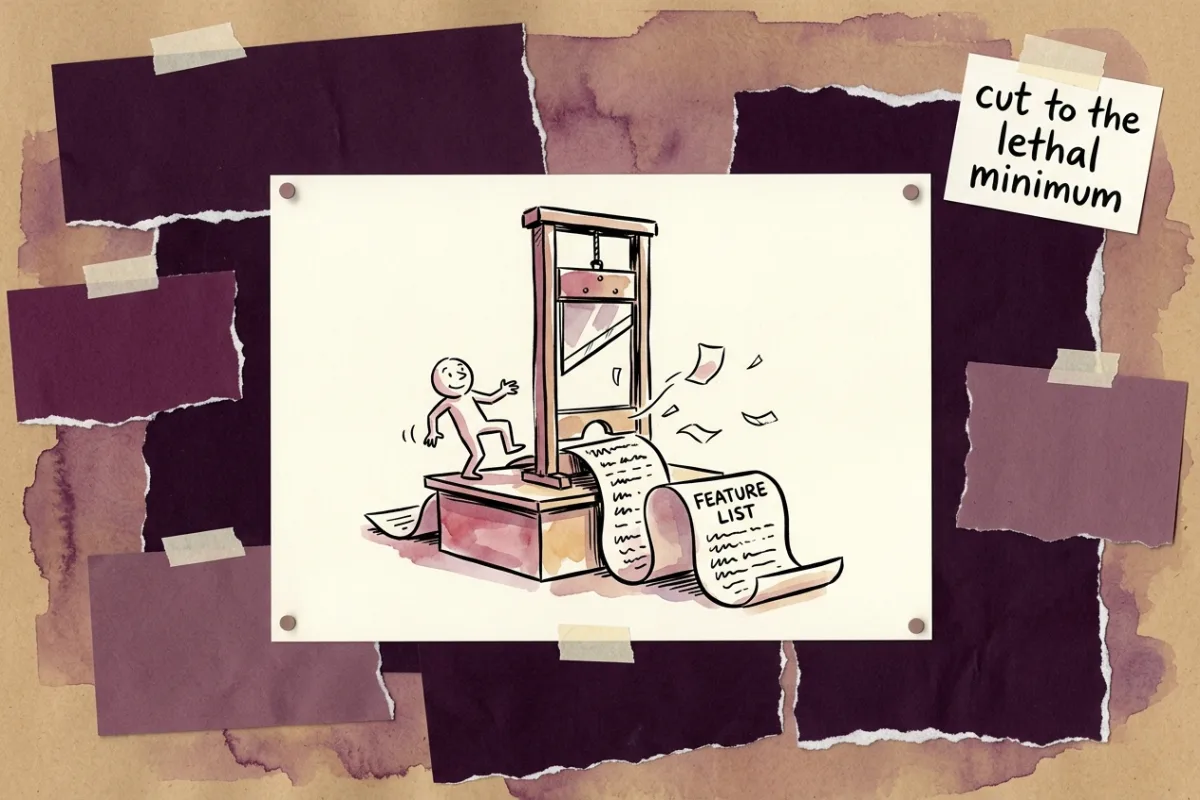
The Scope Guillotine
Find the lethal minimum. Cut to it. Ship. Repeat.
 8 min read
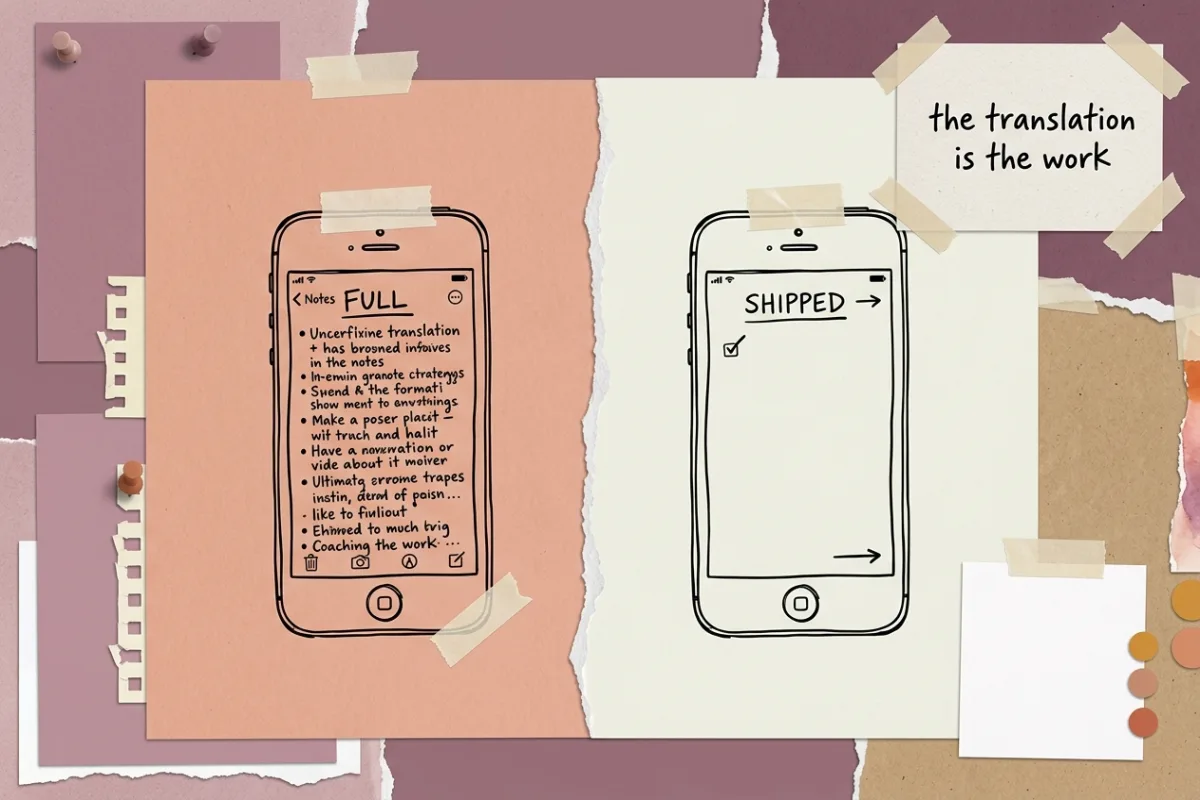
Ideas Aren't the Work
The idea isn't the work. The translation is the work, and you keep skipping it.
 8 min read
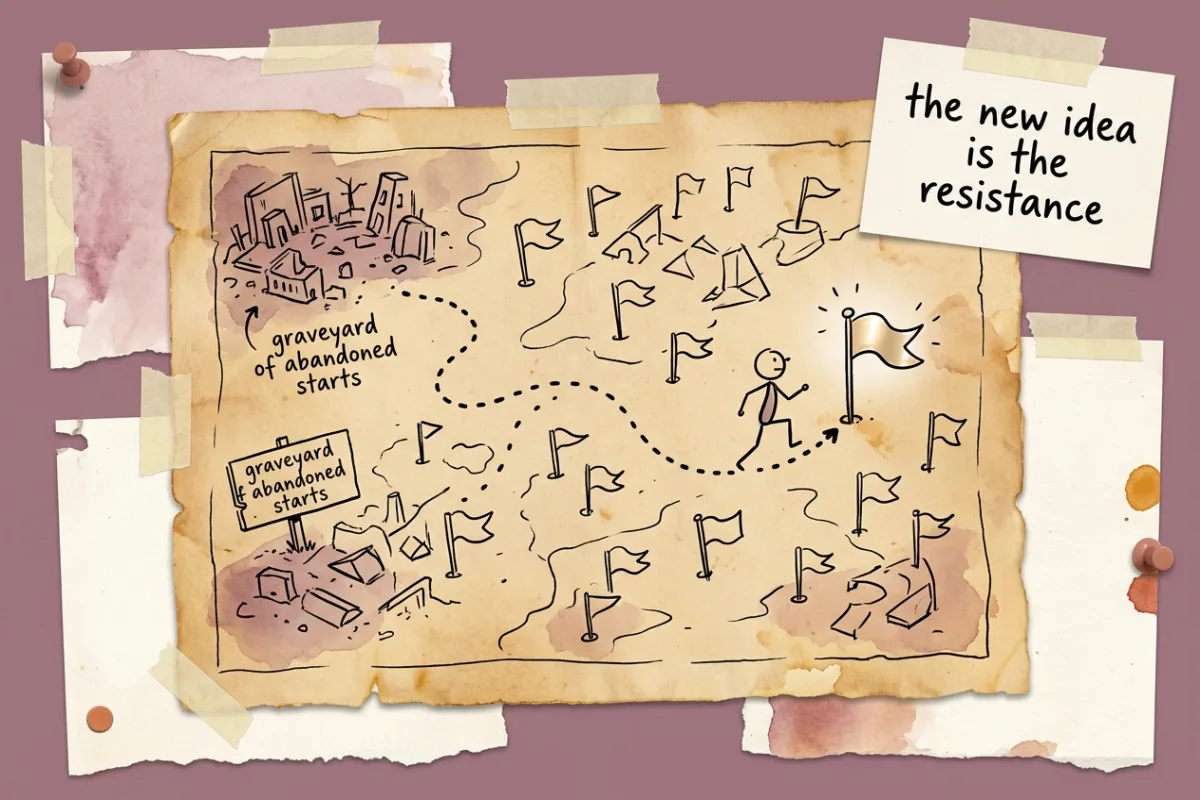
Stop Dating Your Ideas
The high of starting is real. It's also the reason you've finished nothing in three years.
Get one email a week.
A 5-minute read on shipping faster, thinking clearer, and actually finishing what you start. Free.
One a week, give or take. Unsubscribe in one click.
Ready to actually ship?
Reading these essays is the warm-up. Book a free Build Partner call and let's get your project moving.
Request a Free Build Partner Call