
Stop Dating Your Ideas
The high of starting is real. It's also the reason you've finished nothing in three years.
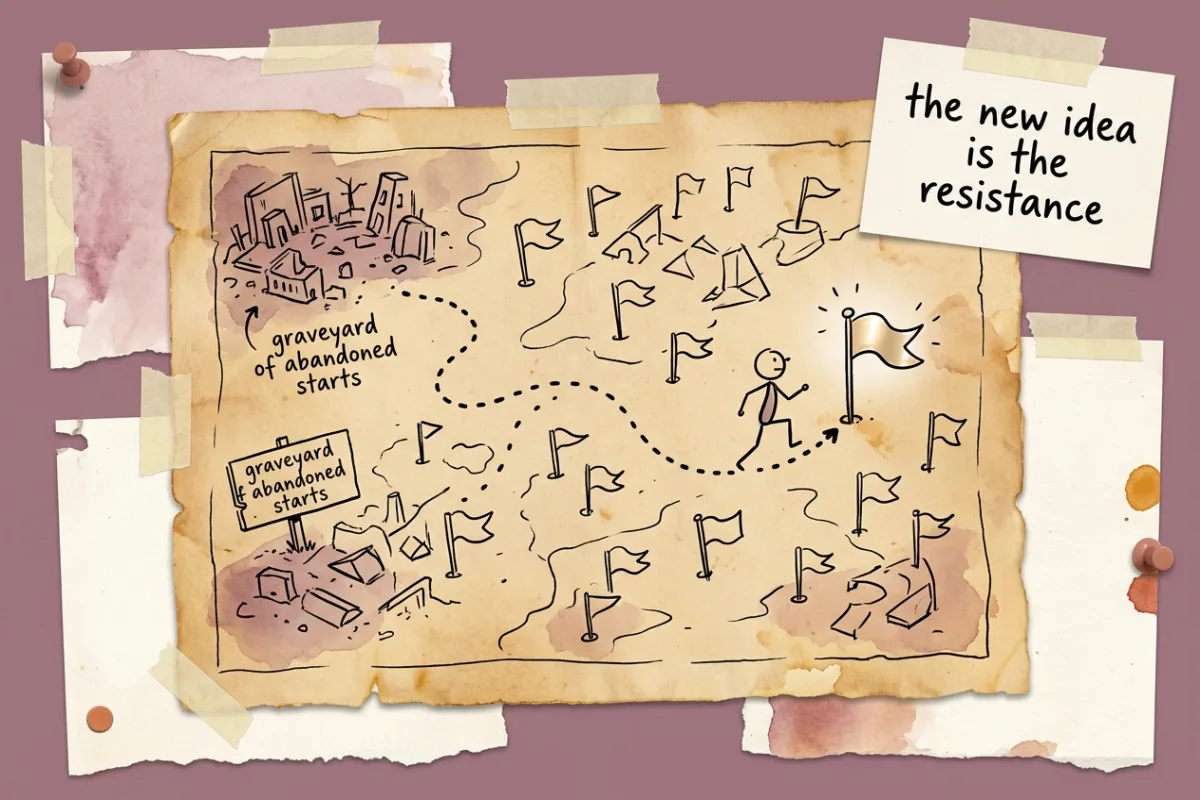
Buying a new domain at 11pm feels like progress. It isn't. The Steven Pressfield rule: the closer you are to finishing, the louder the voice gets that says start something new instead.
Stop Dating Your Ideas
The high of starting is real. It's also the reason you've finished nothing in three years.
It's 11pm on a Tuesday and you just had the best idea you've had in months.
You can see it. You can see the homepage. You can see the launch tweet. You can see the small but real first 100 customers and the part where you tell the story at dinner. You buy the domain. You spin up a new Notion. You sketch the architecture. You feel something in your chest that you haven't felt in eight weeks. You feel like a person who does things.
You go to bed at 1am, exhausted in a good way, planning to start in the morning.
By Sunday the Notion has six pages. By the next Sunday it has the same six pages. By the third Sunday you haven't opened it. By the fifth Sunday you've had a different brilliant idea and bought a different domain.
You did this in 2024. You did it in 2025. You're doing it now.
The pattern isn't a discipline gap. The pattern is a structural feature of how creative brains work, and it has been documented by three people whose books have sold tens of millions of copies, and the reason you keep falling for it is that the system is doing exactly what it's wired to do.
You're not failing at finishing. You're winning at starting, over and over, at the cost of the finish line.
What Steven Pressfield named in 2002
In 2002 Steven Pressfield published The War of Art, a short book about creative work that became gospel for novelists, songwriters, founders, and anyone who has ever had a project that mattered and couldn't move it.
Pressfield's central claim, repeated for 240 pages, is that there is a force that opposes creative work, and the force is real, and the only useful thing you can do about it is name it. He calls it Resistance. Capital R.
The cleanest sentence in the book.
"Resistance is most powerful at the finish line."
Pressfield's claim, supported by his own example and by the working habits of every creative he interviewed across his career, is that the closer you get to actually shipping a thing, the louder Resistance gets. The voice that tells you the idea isn't that great after all. The voice that points out a brand new idea that's better. The voice that suggests you should pivot. The voice that says "let me just clean this part up before I send it." Resistance shows up as creative impulse, but its job is to keep you from finishing.
The 11pm new-domain moment isn't inspiration. It is, almost always, Resistance dressed up as inspiration. It shows up exactly when you're three weeks into the messy middle of the previous thing, because the messy middle is what Resistance attacks.
The diagnostic: any idea that arrives at week three of an existing project, that demands you abandon the existing project, is suspect by default. It might be real. It is more likely to be the system's defense mechanism against having to finish something.
What Seth Godin named in 2007
Five years after Pressfield, Seth Godin published The Dip, a 76-page book that did most of its work in the title.
Godin's argument is that almost every meaningful project has the same shape. There's a euphoric beginning where every step adds output. Then there's a long middle where the work is hard, the rewards are invisible, the momentum drops, and the project stops feeling like a winner. Then, if you push through the middle, there's a steep climb on the other side where the project pays back. Most people quit during the middle, which Godin calls the Dip.
The Dip is not a sign that the project is bad.
The Dip is a structural feature of every project that's actually worth doing.
Godin's claim is that the Dip is the entire moat. The reason the rewards on the other side exist is that most people give up in the middle. If the middle weren't hard, everyone would do it, and the rewards would be lower. Difficulty is the gating function. The Dip is doing its job.
Now apply that lens to your last five abandoned projects.
How far in were you when you quit each one? For most senior operators, the answer clusters around weeks 3-6. That's not a coincidence. That's the Dip. You quit on schedule. You quit at exactly the point where every project that's worth doing gets hard.
You weren't quitting the wrong projects. You were quitting the right ones, on time, repeatedly, for years.

What Adam Grant proved in 2016
Adam Grant is a Wharton organizational psychologist whose 2016 book Originals studied what successful creative people actually do, as opposed to what they say they do in interviews.
Grant's most counterintuitive finding is also the most useful for serial idea-daters.
Successful creators do not generate fewer ideas than unsuccessful ones. They generate the same number, or more. The difference is what they do with them.
Mozart wrote 600+ pieces. Most are not played today. He kept writing through the bad ideas. Picasso made 50,000+ works. Most are not in museums. Edison filed 1,000+ patents. Most you've never heard of. Shakespeare wrote 37 plays. The same shape applies. The successful creator and the unsuccessful one have the same idea volume. The difference is that the successful one finishes the bad ones too. They generate output, watch what works, and keep going.
The unsuccessful version of you generates an idea, falls in love with it, abandons it at the first sign of friction, and starts a new one. The successful version of you generates an idea, takes it to a finished state, finds out it's mediocre, and starts a new one with that information.
Grant's claim, drawn from a wide reading of the creativity research, is that taste — the ability to know what's good — only develops by finishing things and seeing what shipped. The unfinished projects don't develop taste. They develop attachment.
You don't need fewer ideas. You need a higher ratio of finished ideas, even bad ones, to started ones.
Three rules that break the dating loop
You don't fix this with willpower. You fix it with structural rules that survive your worst Tuesday.
1. The new-idea quarantine. When a new domain-buying impulse hits, write the idea down in a separate file labeled "Q4 maybe." Do not open Notion. Do not buy the domain. Do not start a Figma. The capture itself releases most of the cognitive pressure (the Zeigarnik Effect — same one as in the potential is a liability post). Give the idea a 60-day quarantine. If it's still calling your name in 60 days, it's real. If it isn't, it was Resistance.
2. The 6-week finish rule. Whatever you have started right now, finish it in 6 weeks. Bad version. Real launch. Even if it's mediocre. Even if you've fallen out of love with it. The point is not to ship a great thing. The point is to break the pattern of not shipping. Once you finish one bad thing, the next one is easier. This is exactly the structure of the 6-Week Build Partnership. Six weeks. One scope. One launch.
3. No new starts until the current thing closes. This is the rule serial daters break the most. The new project always arrives before the old one is done, and the old one always becomes "stale" in light of the new one. The rule has to be inviolable. One project at a time. The next one starts the day after the current one ships. Not the week before. Not the day of. The day after.
If you can hold those three rules for one cycle, the pattern breaks. You'll finish a thing. The thing will probably be mediocre. You'll learn what it actually felt like to take a thing across the finish line. The next idea will benefit from that information.
You can't think your way to taste. You have to ship your way to taste.
The reframe
You're not undisciplined.
You're being attacked by Resistance at exactly the points it's supposed to attack. You're quitting in the Dip on schedule. You're confusing idea generation for output, and you're not alone — Mozart did the same thing for the first 200 pieces of his career, and he's the example.
You don't need more ideas. You need to finish the bad version of the one you started in March.
The next idea will arrive. Quarantine it. Stay on the current thing. Ship in 6 weeks.
That's the whole game.

More for The Scattered Starter
 9 min read
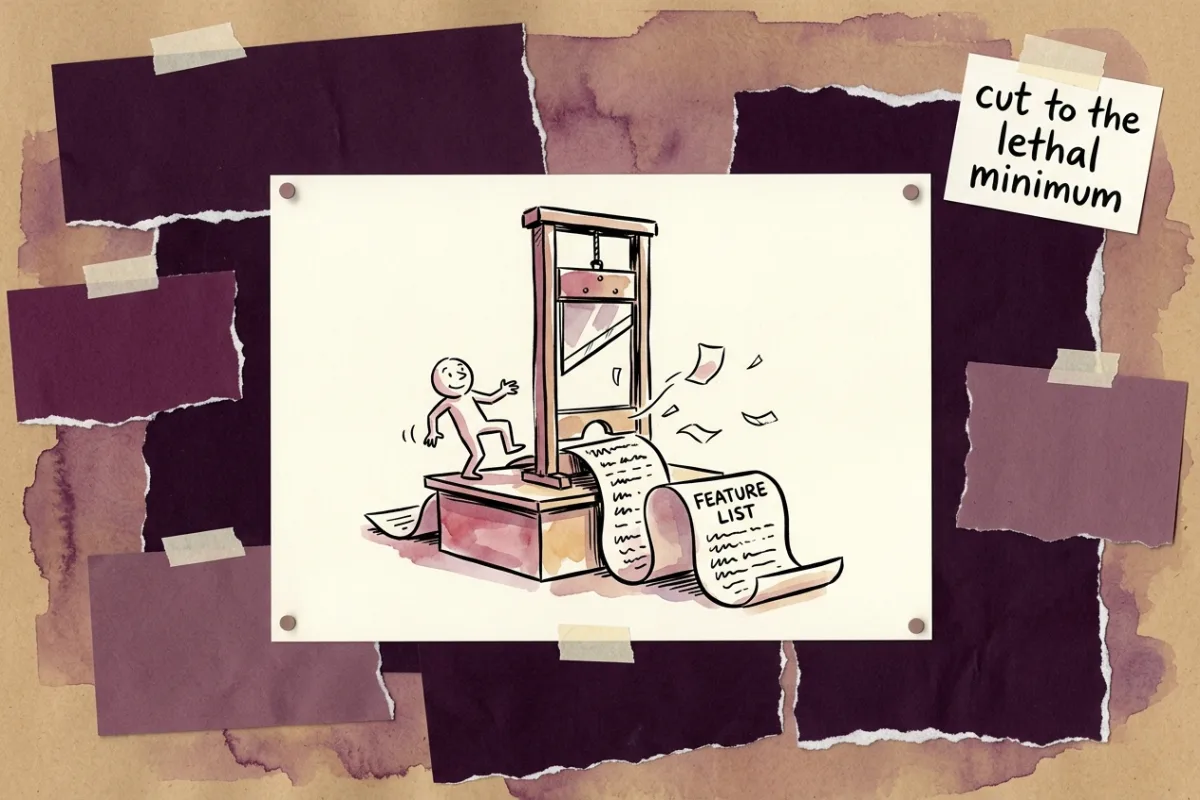
The Scope Guillotine
Find the lethal minimum. Cut to it. Ship. Repeat.
 8 min read
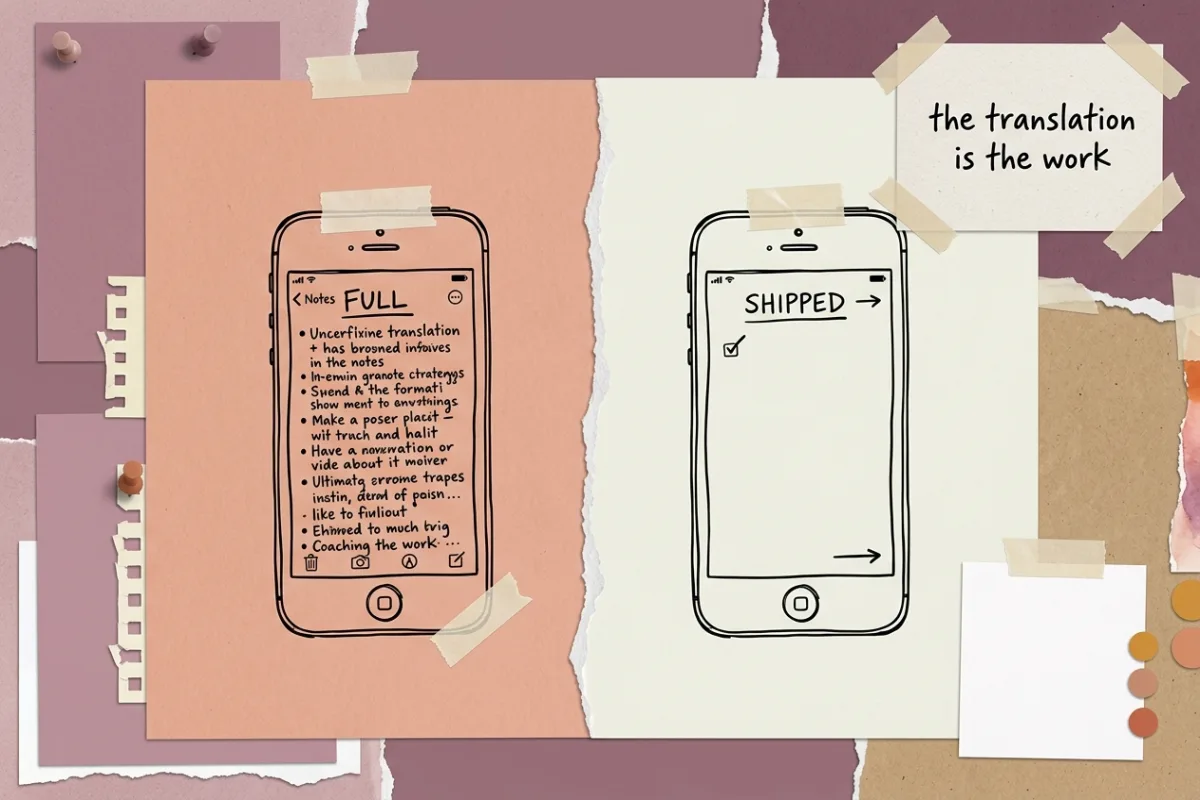
Ideas Aren't the Work
The idea isn't the work. The translation is the work, and you keep skipping it.
 7 min read
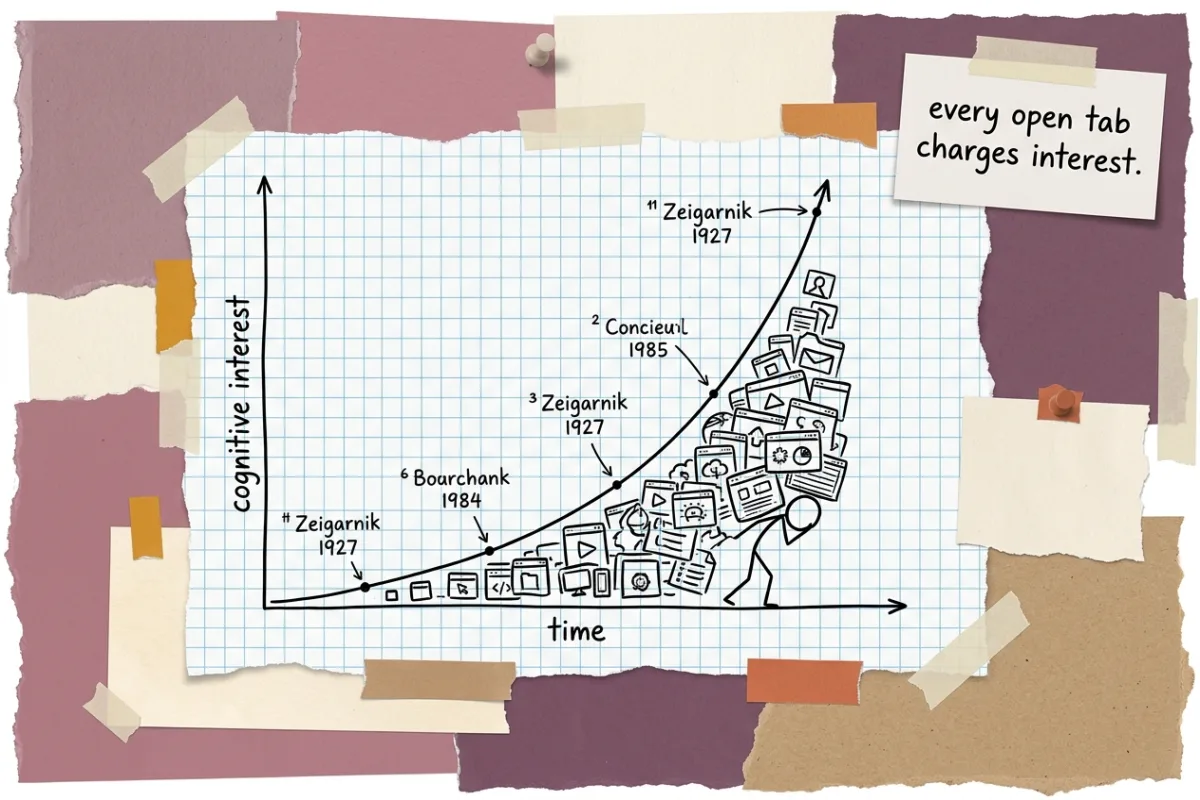
Your Potential Is a Liability
Every unfinished idea you're carrying is charging you cognitive interest, whether you've cashed it in or not.
Get one email a week.
A 5-minute read on shipping faster, thinking clearer, and actually finishing what you start. Free.
One a week, give or take. Unsubscribe in one click.
Ready to actually ship?
Reading these essays is the warm-up. Book a free Build Partner call and let's get your project moving.
Request a Free Build Partner Call