
02.The Wait for Clarity Fallacy
Why Your Need for Certainty is Killing Your Growth
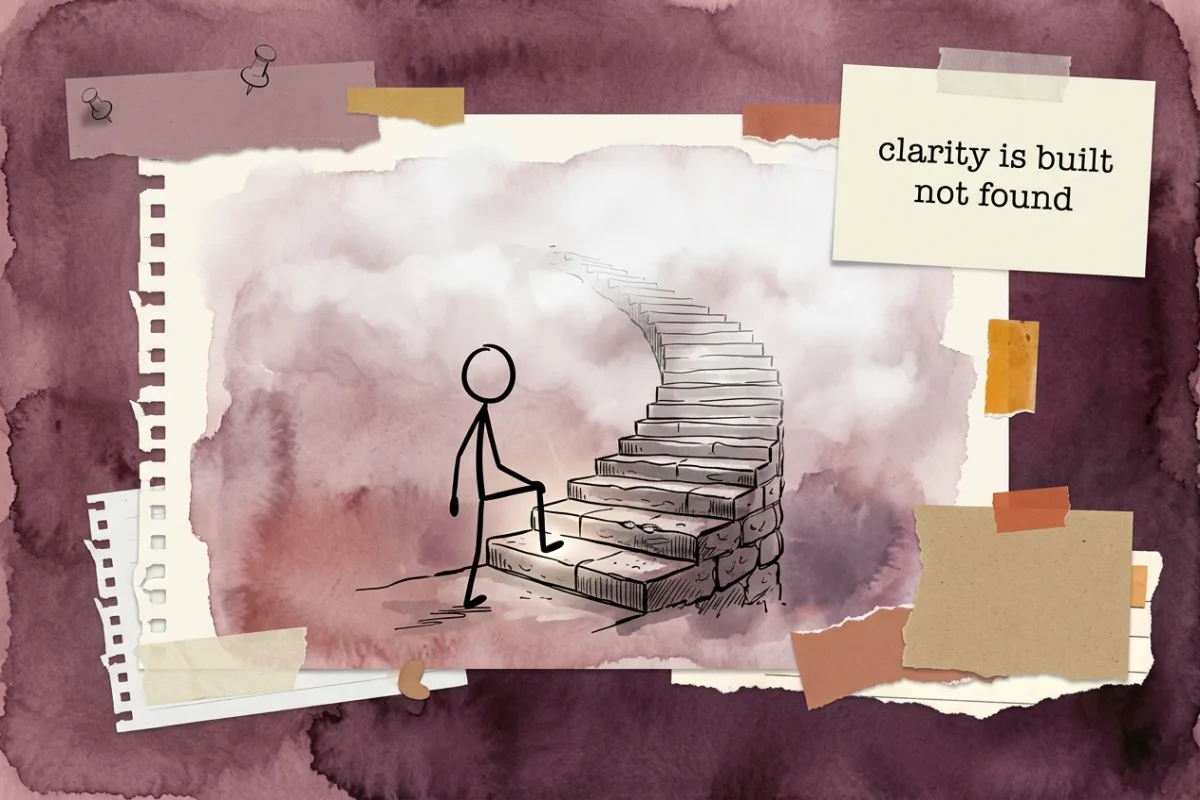
Clarity isn't something you find — it's something you build through action. Here's the OODA Loop, Type 1 vs Type 2 decisions, and why shipping beats strategizing.
You say you're "waiting for clarity."
I say you're hiding in the fog.
Here's the truth nobody wants to hear: Clarity isn't something you find, it's something you build through the wreckage of your own mistakes. If you wait until you can see the whole staircase, you'll die on the first floor.
I see this pattern constantly with high-achievers who've hit a ceiling. They've got the credentials, the track record, the capital. But they're frozen. Paralyzed by the need to have the "perfect strategy" before they make a move. They call it "being strategic." I call it procrastination with a graduate degree.
The High-IQ Excuse for Doing Nothing
Let's be blunt: Waiting for clarity is just a socially acceptable way to avoid risk.
It sounds so reasonable. "I'm just doing my due diligence." "I need more data." "I want to make sure I have the right foundation."
Meanwhile, someone with half your credentials and twice your audacity is shipping something imperfect and eating your lunch.

The real kicker? The people who "wait for clarity" aren't even waiting for clarity. They're waiting for certainty, which doesn't exist. They want a guarantee that their investment will pay off, their system will work, their pivot won't fail.
Newsflash: The market doesn't hand out guarantees. It rewards speed and adaptation. And every day you spend "seeking clarity" is a day someone else is building momentum you'll never catch.
Sara Blakely Didn't Wait for Permission
Let me tell you about Sara Blakely.
In 1998, she was 27 years old, selling fax machines door-to-door in Florida. No business degree. No fashion background. No manufacturing connections. No startup capital beyond her $5,000 in savings.
She had an idea, footless pantyhose, and a pair of scissors.
Most people in her position would have "waited for clarity." They would have spent years researching the hosiery market, attending fashion school, networking with manufacturers, building a "comprehensive business plan."
Blakely did the opposite. She cut the feet off her own pantyhose, wore them under white pants, and thought, "This should exist."
Then she moved.
She cold-called hosiery mills. She got rejected. She called more mills. She wrote her own patent (because she couldn't afford a lawyer). She convinced a mill owner's daughters to back her. She got a meeting with Neiman Marcus by literally walking into the women's restroom and showing the buyer how the product worked.
She built Spanx while she was still selling fax machines.
She didn't have clarity. She didn't have certainty. She had forward motion.
Today, Spanx is a billion-dollar company. And Blakely didn't need a 10-year plan to get there. She needed a "today" system, and the willingness to figure it out as she went.
The Corporate Refugee Who Spent $50K on Paralysis
Now let me show you the opposite story.
I know someone: let's call him David: who spent 15 years at a Fortune 500 company. VP-level. Great salary. Golden handcuffs.
He wanted out. He wanted to start his own thing. He had the savings, the network, the expertise.
So what did he do?
He hired consultants. Lots of them.
He spent $50,000 over 12 months on market research, competitive analysis, brand strategy, and a "comprehensive go-to-market plan." He attended conferences. He read books. He had so much clarity.
By the time he was ready to launch, the market had moved. The gap he identified? Three scrappy startups had already filled it. The "clarity" he paid for? Outdated before he used it.
David is still at the Fortune 500. Still waiting for the "right time."

Here's the difference: Sara Blakely had a bias toward action. David had a bias toward analysis.
One built through iteration. The other built a beautiful plan that collected dust.
Clarity is a Byproduct, Not a Prerequisite
This is the part where I lose the MBAs.
A system doesn't require a 10-year vision. It requires something that works today — and the discipline to improve it tomorrow.
Think about it: When Amazon started, Jeff Bezos didn't have "clarity" on AWS, Prime, or Alexa. He had a system for selling books online. Then he iterated. The infrastructure evolved because of action, not before it.
When Spanx started, Sara Blakely didn't have "clarity" on licensing deals, retail expansion, or product lines. She had a prototype and a pitch. The rest came from shipping and learning.
This is what the "wait for clarity" crowd misses: You don't get clarity by thinking harder. You get clarity by moving faster.
The OODA Loop: Infrastructure for Pivoting
If you want to build a system that thrives in uncertainty, you need to understand the OODA Loop.
It was created by John Boyd, a fighter pilot and military strategist. It stands for:
- Observe: What's happening in your market, your operations, your customer feedback?
- Orient: What does this data mean? What patterns are emerging?
- Decide: Based on what you see, what's the smallest move you can make?
- Act: Ship it. Test it. Learn from it.
Then repeat: faster than your competition.
The OODA Loop isn't about perfection. It's about speed. The person who can complete the loop faster: who can observe, orient, decide, and act while their competitor is still "seeking clarity": wins.
This is a system for the real world. Not the fantasy world where you have all the data before you move.

Type 1 vs. Type 2 Decisions: The Bezos Framework
Jeff Bezos has a simple rule for decision-making:
Type 1 Decisions are one-way doors. Once you walk through, you can't come back. These require careful thought.
Type 2 Decisions are two-way doors. You can walk through, test, and walk back if it doesn't work.
Here's the problem: Most people treat all decisions like Type 1 decisions. They agonize over choosing a CRM, a brand color, a pricing model: as if these choices are irreversible.
They're not.
The majority of your decisions are Type 2. You can pivot. You can iterate. You can change course.
But you can't do any of that if you're still sitting in the lobby, "waiting for clarity."
The Real Cost of Delay
Let's do some math.
If you wait 12 months to "get clarity" before building your system, and your competitor ships an imperfect version in 3 months, who wins?
Your competitor has 9 months of:
- Customer feedback
- Revenue data
- Market validation
- Iterative improvements
You have a pristine strategy document.
Even if your system is "better" when you finally launch, you're starting from zero. They're starting from version 9.0.
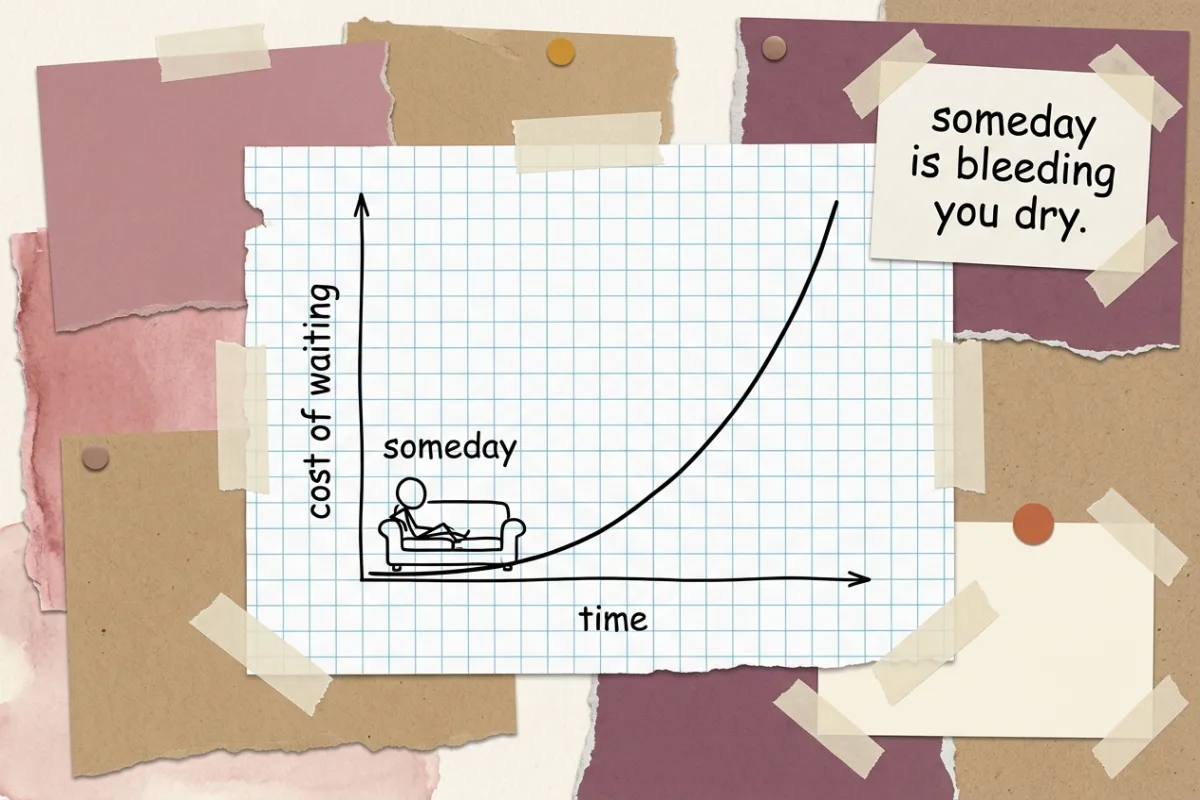
The cost of delay isn't just lost revenue. It's lost learning. And in a world where speed beats perfection, that's fatal.
Start Walking
Here's your action step:
Identify one decision you've been delaying because you "need more clarity."
Then ask yourself: Is this a Type 1 or Type 2 decision?
If it's Type 2 (and most are), ship the 70% solution today. Observe what happens. Orient based on the data. Decide on the next move. Act again.
The OODA Loop doesn't work in theory. It works in motion.
The map is not the territory. Stop staring at the compass on top of your mountain of crumpled-up plans.
Start walking.
Get one email a week.
A 5-minute read on shipping faster, thinking clearer, and actually finishing what you start. Free.
One a week, give or take. Unsubscribe in one click.
Ready to actually ship?
Reading these essays is the warm-up. Book a free Build Partner call and let's get your project moving.
Request a Free Build Partner Call