
You Don't Need a Fractional CTO
What senior tech leaders actually need is a build partner, not another hire.
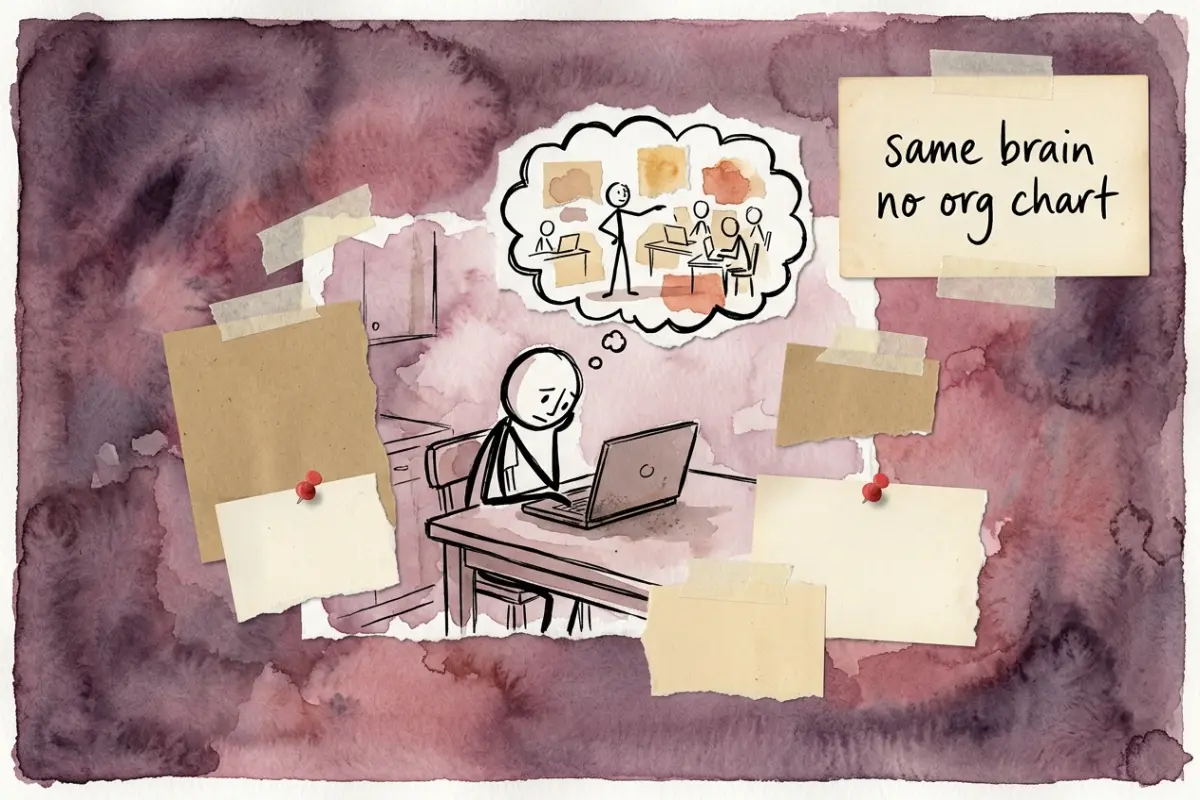
It's Saturday morning. Your side project hasn't moved in three weeks. Monday at work you'll unblock five teams before lunch. Same brain. Same skills. No org chart. The fix isn't another hire.
You Don't Need a Fractional CTO
What senior tech leaders actually need is a build partner, not another hire.
It's a Saturday morning in March. You sit down with coffee and open the side project you've been meaning to get to for nine weekends in a row. Your IDE remembers what you opened. Your brain doesn't. You stare at the half-built dashboard, close the tab, open Slack to clear three "quick" things from work, and three hours later it's lunchtime and the project hasn't moved.
Monday at work you'll unblock five teams before noon.
Same brain. Same skills. No org chart.
The fix you keep googling for is a fractional CTO. Eight hours a week. $4,000 a month. Someone with the resume to "vet your architecture." It feels right because it's the org-shaped answer. At work you'd hire a person. At home you should hire a smaller version of a person.
Wrong answer.
You don't have a senior-engineer-shortage problem on a side project. You have a single-point-of-failure problem, and the failing point is you.
The competence trap
You're senior because you can do most things yourself. Promotion math rewarded that. You wrote the spec, debugged the deploy pipeline, ran the standup, and apologized to the customer in the same week, more than once, for years. By the time you were 35 you had built a reflex. When something is broken, you fix it. When something is unclear, you write it. When the team is stuck, you unstick them.
That reflex is exactly why you can't ship your own thing.
At work you have the reflex AND a structure. There's a PM whose entire job is to ask if a feature should exist. There's a designer who tells you what the user actually clicks on. There's a QA team that says "no, that's not done." There's a deploy pipeline someone else maintains.
At home, you are all of those people. You are also the customer. You are also the executive sponsor who has to keep believing in the thing on a Tuesday at 9pm when the dishwasher is broken and your kid wants help with math.
You're not stuck because you lack skill. You're stuck because there's no other you.

A "fractional CTO" is the wrong primitive
The category exists for a reason. Series-A startups hire fractional CTOs because they have $200K of runway burning per month, real customers, and zero technical leadership. The fractional CTO writes the architecture, hires the first three engineers, sets the deploy strategy, and rotates out at month nine when the full-time CTO takes over.
Your side project has none of those problems.
You don't need an architect. You're an architect. You don't need someone to hire engineers. You're not hiring engineers. You don't need someone to set the deploy strategy. You'll deploy it on Vercel like everyone else.
What you don't have, and can't generate alone, is the second voice. The person who reads your scope and says "this is three projects, pick one." The person who looks at the feature list and asks "what would happen if you just shipped a worse version on Friday?" The person who notices that you've redesigned the login screen four times and haven't finished the actual product.
That isn't a CTO. That's a build partner.
What Tiny Speck actually did
You've heard the Slack origin story. Stewart Butterfield's team built a failing massively-multiplayer-online game called Glitch, ran out of runway in 2012, and pivoted into a chat tool that became Slack.
What gets cut from the founder-mythology version is who did the pivoting.
Tiny Speck wasn't Stewart Butterfield alone in a room. Butterfield had three co-founders — Cal Henderson, Eric Costello, and Serguei Mourachov — and a 45-person team. When Glitch failed, Butterfield wrote one of the most-quoted internal memos in tech history, the "Wall of Sound" letter, explaining the wind-down. Then the team made a series of decisions, together, over weeks, about what to keep, what to release, who to lay off, and what to build next.
The chat tool they had built for themselves to run the game studio became Slack. Cal Henderson, the CTO, led the engineering rebuild. Butterfield led the narrative rebuild. Costello led the design rebuild. Three people, three voices, three permission slips for cutting Glitch in half and turning the leftovers into a $27 billion product.
If Stewart Butterfield had been alone in his living room, Glitch would still be in his side-projects folder.
What Reid Hoffman actually did
Same story, different shape.
Reid Hoffman left PayPal in 2002, but he didn't go off and build LinkedIn solo from his living room. He co-founded LinkedIn with four people he had worked with at SocialNet, his previous failed company: Allen Blue, Konstantin Guericke, Eric Ly, and Jean-Luc Vaillant. He wrote about this in his 2018 book Blitzscaling. He's been explicit, in interviews going back to 2012, that the co-founder team wasn't a nice-to-have. It was the only reason LinkedIn shipped before the cash ran out.
Hoffman has a line he repeats. "No matter how brilliant your mind or strategy, if you're playing a solo game, you'll always lose out to a team."
He's not talking about hiring a fractional CTO. He's talking about the second voice.

What Marshall Goldsmith named
In 2007 Marshall Goldsmith, the executive coach who has worked with more Fortune 100 CEOs than anyone alive, published a book with the long title What Got You Here Won't Get You There. The whole thesis fits in the title.
The skills that made you successful as an individual contributor are the same skills that prevent you from being successful at the next level. The reflexes that earned you "senior" — fix it yourself, write it yourself, ship it yourself — are the reflexes that drown you the moment the work outgrows what one person can do alone.
Goldsmith was writing about executives moving into the C-suite. The same dynamic applies, almost without translation, to senior tech employees trying to ship side projects. You're not failing your side project because you lack the skill that got you here. You're failing because you're still using only that skill.
The skill you're missing is the meta-skill of building with a second voice in the room.
The infrastructure asymmetry
Look at your work setup tomorrow.
You have a roadmap. A backlog. A weekly review. A status doc. A PM who runs the planning meeting. A designer who owns the visuals. A QA process that catches the things you missed. A deploy pipeline. A monitoring dashboard. A Slack channel for stuck. A retrospective every two weeks.
Now look at your side project.
A folder in iCloud. A Notion doc you stopped updating two months ago. Three browser tabs open in a stale Chrome window. One untested Stripe webhook.
Same brain. Same skills. No infrastructure.
People keep telling you to be more disciplined. Discipline isn't the gap. The gap is everything around you that's missing.
What to do this week instead of hiring a fractional CTO
You don't need to spend $4,000 a month. You need to introduce a second voice into the system. There are three real options. They cost less and work better.
1. Run a Build Audit. Two hours, one document, one outside person who has shipped things and can read your project end-to-end. The output is a one-page assessment of what to cut, what to ship, and what to ignore until V2.
2. Apply scope lock to the next 6 weeks. Pick the one feature your project needs to be useful to one user. Cut everything else. Print the scope. Stick it on the wall. If a new idea shows up, it goes on a separate "V2 maybe" list. The Scope Guillotine isn't a metaphor. It's a real cut.
3. Find one second voice. A fractional CTO is too expensive and too senior for a side project. A peer who ships, an old colleague who is also building, or a build partner is the right altitude. The job description is short. Read your work weekly. Ask three uncomfortable questions. Refuse to let you keep redesigning the login screen.
If you want help doing all three at once, that's what the 6-Week Build Partnership is.

The reframe
You're not lazy. You're operating without infrastructure.
You're not under-skilled. You're using the same skill you used to climb the org chart, in a context where that skill alone isn't enough.
You don't need a fractional CTO. You need the second voice that, at work, you have eight of by accident.
Pick the one decision you've been carrying alone for the last two weeks. Tell it to one person whose opinion you respect. Hear what they say. Decide. Move.
That's the system. The system is just the second voice, applied weekly, until the thing ships.

More for The Overcommitter
 8 min read
The Infrastructure Mismatch
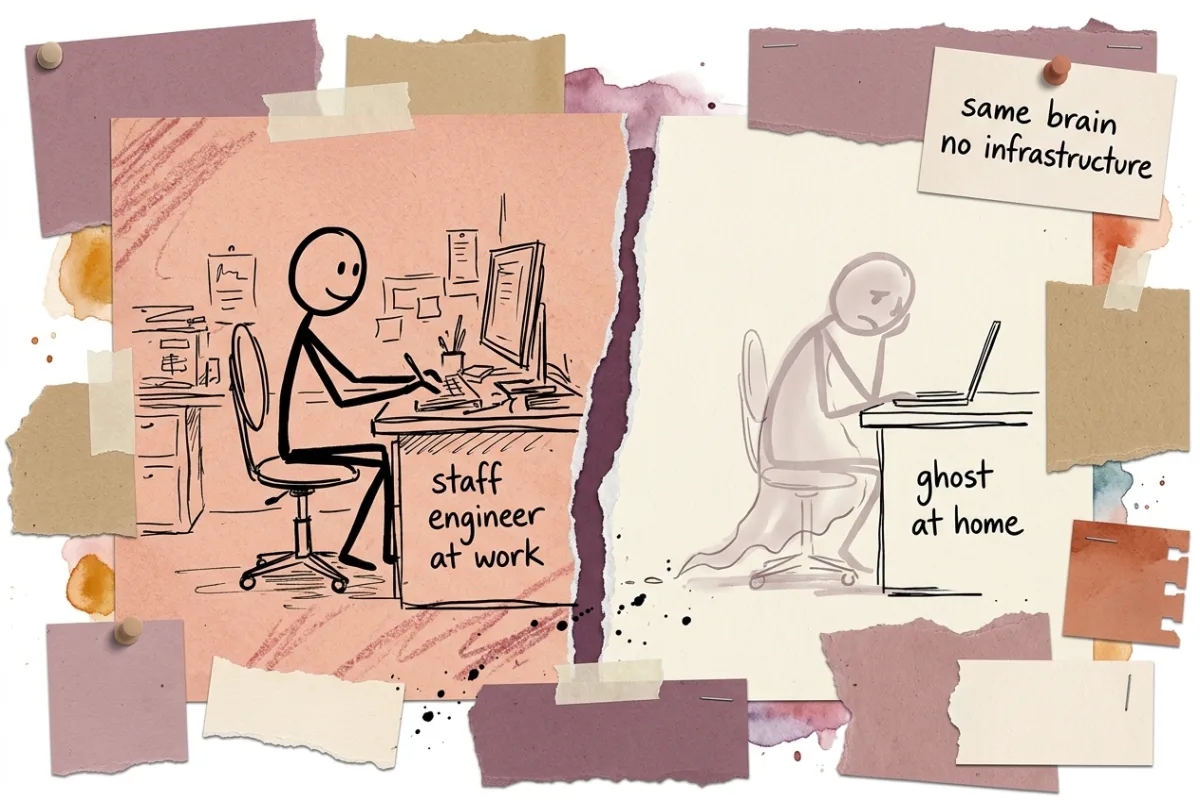
Why You're a Staff Engineer at Work and a Ghost at Home
 7 min read
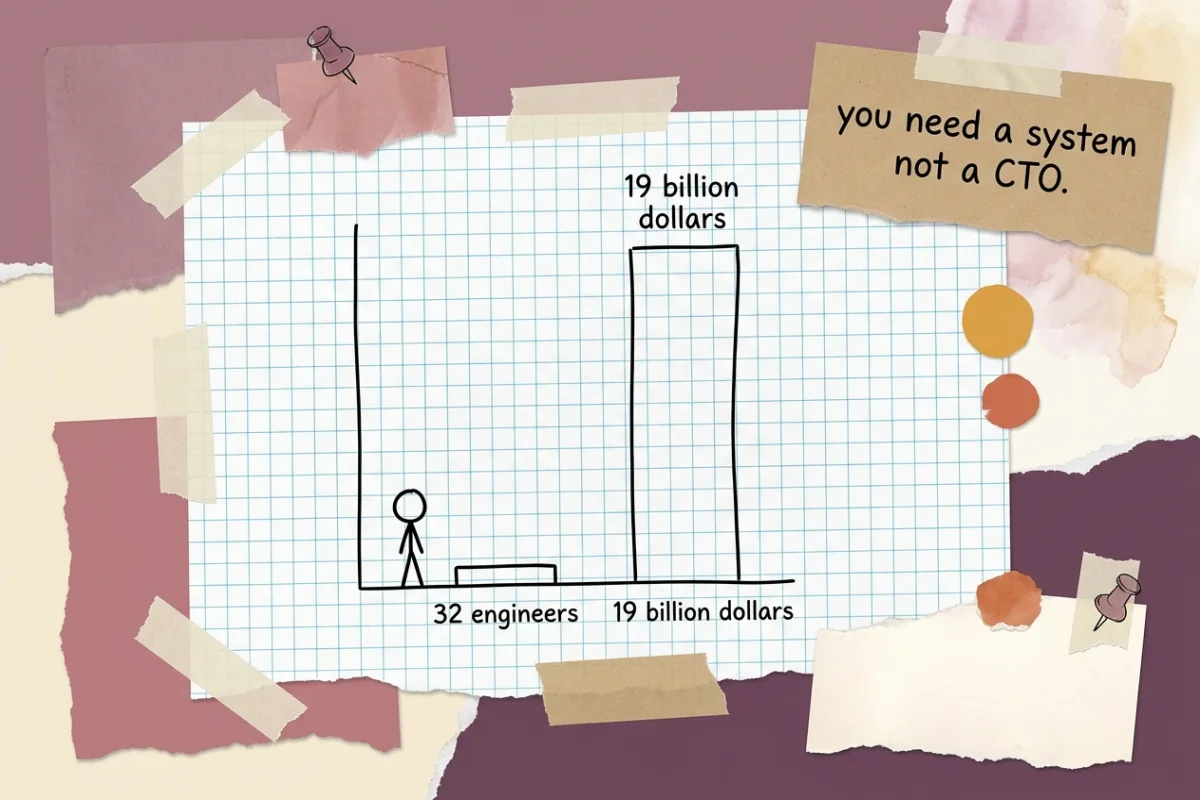
Stop Hiring Your Way Out of a Systems Problem
Most early-stage founders are trying to hire their way out of a systems problem.
 8 min read
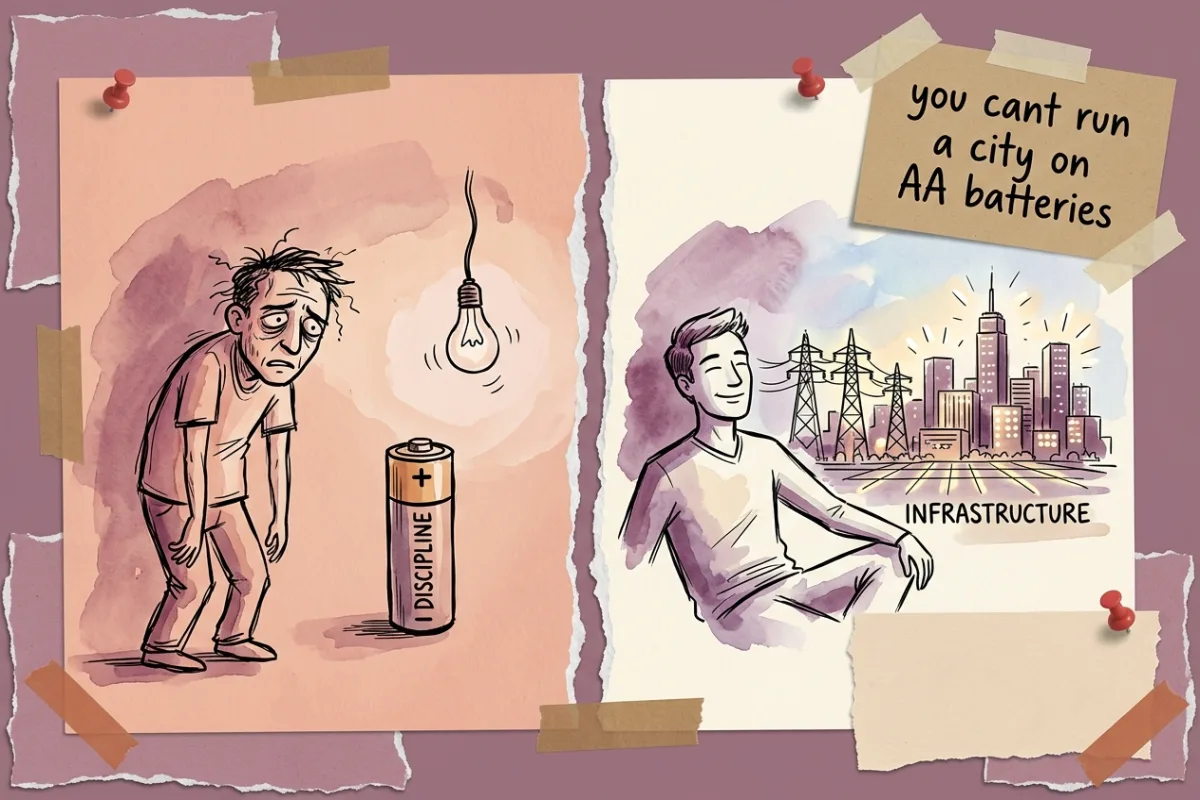
You Don't Have a Discipline Problem
Discipline is a battery. Infrastructure is a power grid. You've been trying to run a city on AA batteries.
Get one email a week.
A 5-minute read on shipping faster, thinking clearer, and actually finishing what you start. Free.
One a week, give or take. Unsubscribe in one click.
Ready to actually ship?
Reading these essays is the warm-up. Book a free Build Partner call and let's get your project moving.
Request a Free Build Partner Call