
You Don't Have a Discipline Problem
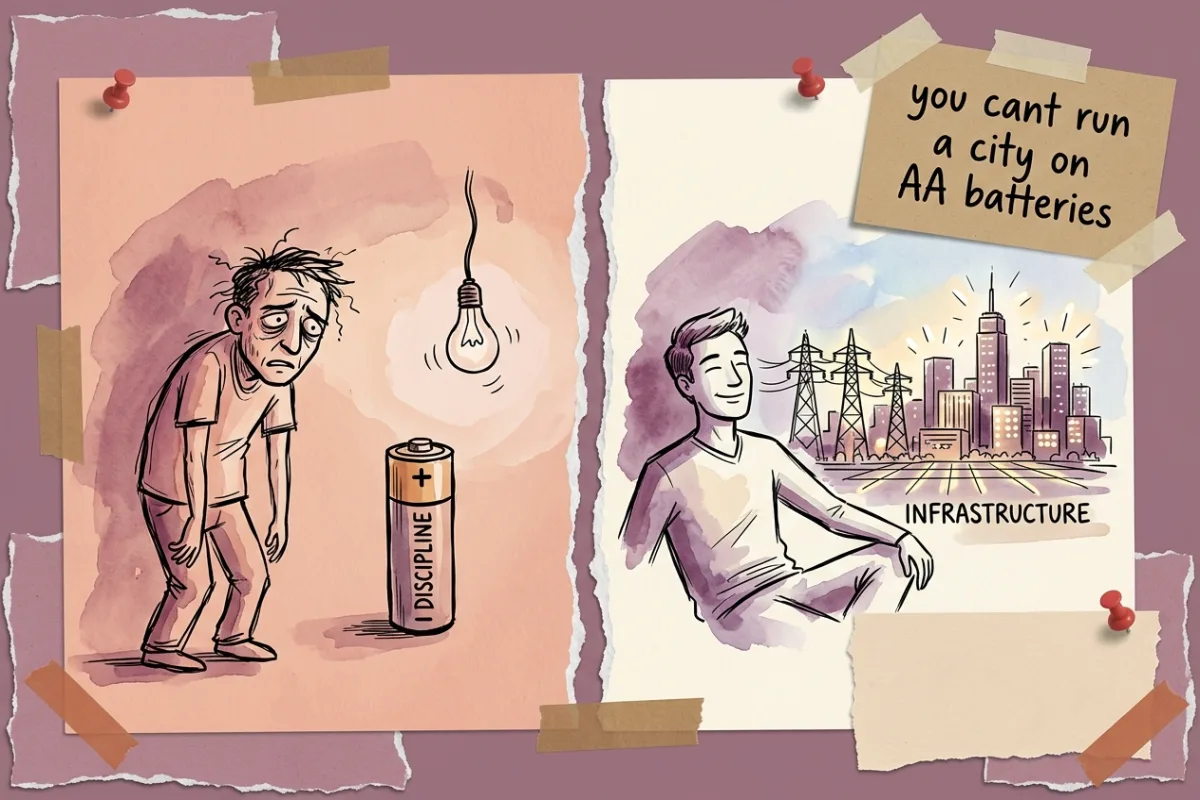
Discipline is a battery. Infrastructure is a power grid. You've been trying to run a city on AA batteries.
You don't lack discipline. The Ferrari is fine. The engine is fine. You're sitting on blocks because nobody installed the wheels, and willpower can't compensate for missing transmission.
You Don't Have a Discipline Problem
Discipline is a battery. Infrastructure is a power grid. You've been trying to run a city on AA batteries.
It's 9pm on a Tuesday and the cursor on your laptop hasn't moved in twenty minutes.
The plan for the day, written six hours ago when you were optimistic, was to ship the v1 deploy of the side project. Instead you spent the day in 14 reactive conversations, two meetings that should have been Slack threads, and one 90-minute review of someone else's plan that nobody read in advance. The strategic deep-work block you put on your calendar at 2pm got eaten by a thing that felt urgent at 1:55pm. By 6pm you were tired. By 8pm you couldn't remember what the deep-work block was supposed to produce.
The voice arrives on cue.
If I had more discipline, I'd be done. I'm losing my edge. Other people don't have this problem.
Stop. The voice is wrong. The voice has been wrong for three years. The voice will be wrong tomorrow if you let it run again.
You don't have a discipline problem. You have a structural one. The reason you keep mistaking the structural problem for a discipline problem is that the structural problem is invisible to you, and the discipline narrative has been the dominant cultural story about high performance for a hundred years.
The story is wrong. The research has been clear for three decades. The senior operators who ship are not running on more discipline than you. They're running on infrastructure that doesn't ask them to.
What Anders Ericsson actually found
For thirty years, until his death in 2020, Anders Ericsson was the world's leading researcher on the science of expertise. He spent his career studying chess masters, surgeons, violinists, athletes, and any other domain where measurable expertise existed. The methodology was always the same. Compare the elite performers to the merely good ones. Find the variable that explains the difference. Replicate.
In 1993 Ericsson and two colleagues published a paper in Psychological Review called "The Role of Deliberate Practice in the Acquisition of Expert Performance." The paper kicked off a thirty-year research program. In 2016 he summarized the lifetime of work in a book called Peak: Secrets from the New Science of Expertise.
The popular version of Ericsson's finding is "the 10,000 hour rule," made famous by Malcolm Gladwell. Ericsson spent the last twenty years of his life correcting that version because it left out the part that mattered. The hours were not the variable. Deliberate practice was the variable.
Deliberate practice has a specific definition. The practice has to be designed with a specific learning goal. The practice has to happen in a context where there is immediate feedback. The practice has to be at the edge of the practitioner's current capability. The practice has to be repeated, with adjustments, over time. None of these conditions are about willpower. All of them are about structure.
Ericsson's most counterintuitive finding, replicated dozens of times, was that elite performers did not show higher self-reported discipline than the merely good ones. They showed better-designed practice environments. Their teachers structured their hours. Their feedback loops were tighter. Their schedules were protected by other people. The discipline you see in elite performers is the output of a well-designed environment, not the input.
The practitioners who tried to brute-force expertise on their own willpower, without the structural conditions, plateaued. The ones who had the structural conditions, even at lower stated motivation, kept improving.
Apply Ericsson to your project. You are trying to brute-force a complex creative output on willpower, in a calendar that has no protection, with no feedback loop, in an environment that interrupts you 14 times before lunch. The infrastructure for deliberate practice does not exist. Of course you can't will it into being.
The fix isn't more discipline. The fix is the structural conditions Ericsson spent thirty years naming.
What Cal Newport documented in 2016
Cal Newport is a Georgetown computer scientist who in 2016 published Deep Work: Rules for Focused Success in a Distracted World. The book has sold over a million copies and given a name to what most senior operators have lost without noticing.
Newport's core argument, drawn from a wide reading of attention research, is that "deep work" — the focused, cognitively-demanding effort that produces creative output — has become structurally rare in modern knowledge work. The default environment of most operators is a constantly-interrupted state where attention is fragmented across dozens of micro-tasks. The state is not productive. It is the appearance of productivity.
The Sophie Leroy paper from the potential is a liability post is one of the studies Newport leans on. Attention residue from one task contaminates the next. The effect compounds. By 4pm a senior operator who has been responsive all day has accumulated so much residue that the deep-work block they put on the calendar at 4pm is structurally impossible. The block is on the calendar. The brain that was supposed to occupy the block is not available.
Newport's prescription is uncomfortable for most operators because it is structural rather than personal. Block protected hours, in writing, that are non-negotiable. Reduce the input bandwidth (Slack, email, phone) for those hours to zero. Make the environment such that interruption is not possible, not just discouraged. Write the rules down. Tell the team. Hold the line.
The senior operators who do this consistently produce output that the ones who don't can't match. Not because their discipline is higher. Because the environmental conditions are.
You have not been failing at discipline. You have been failing to install the conditions Newport describes. The two failures have completely different fixes. One is about you. The other is about the calendar.

What Greg McKeown drilled in 2014
Greg McKeown is a former Apple-and-Google strategy consultant who in 2014 published Essentialism: The Disciplined Pursuit of Less. The title contains a specific kind of irony.
McKeown's argument is that the most useful form of discipline is the one nobody talks about. The discipline of saying no.
Most senior operators have an aggregate yes-rate that is structurally too high. They say yes to the meeting. Yes to the favor. Yes to the side conversation. Yes to the project that's slightly off-thesis. Yes to the customer ask that should have been a polite redirect. Each individual yes feels small and reasonable. The aggregate is a calendar so full that the most important work cannot fit.
McKeown's claim, repeated for 240 pages, is that the no-rate is the lever. Not the work-harder lever. The cut lever. Most senior operators cannot cut, because they have built their identity on being responsive, capable, and willing to step in. The cut feels like a betrayal of the identity. So they don't cut. So the calendar stays full. So the most important work stays unshipped.
The systematic version of saying no is not about willpower in any individual moment. It's about pre-deciding, in writing, what the project is and what is not the project, and using that document to triage every incoming ask. The Scope Guillotine, applied to your week instead of your roadmap.
The senior operators who have a working scope guillotine on their week are not more disciplined than you. They have a document and a default. The document does the work. The default does the work. The willpower is not the variable.
Three structural moves that replace discipline
You don't fix this with a Sunday-night vow. You fix it with three structural changes that survive your worst Tuesday.
1. Block one 4-hour deep-work session per week, immovable. Same time, same place, same week, no exceptions. Tell three people. Put it on the calendar. Decline anything that conflicts. The Newport move. Most senior operators have not protected a 4-hour creative block in over a year. The block itself is the rare resource. Without it, no Ericsson-style deliberate practice can happen, and no real output can compound.
2. Write down what's not the project. One page. Pick the project. List five things that are explicitly out of scope for the next 6 weeks. Stick the page on the wall. Use it as the triage filter for every "quick favor" and "small ask" that arrives. The McKeown move. The list does the work that your willpower has been failing at, because the list is visible and the willpower was not.
3. Build one feedback loop that's faster than weekly. A daily 10-minute review. A Slack channel where you and one other person post yesterday's commit and today's commit. A morning standup with yourself in writing. Whatever shape it takes, the rule is that the cycle has to be daily, not weekly, because Ericsson's research is unambiguous that fast feedback is the structural feature that distinguishes deliberate practice from busywork.
If you want a second voice in the room while you install all three, that's exactly what a 6-Week Build Partnership is.
The reframe
You are not undisciplined.
You are running a creative operation in an environmental design that makes the kind of output you want structurally improbable, and you have been blaming the operator instead of looking at the environment.
The Ferrari is fine. The engine is fine. You're sitting on blocks because the wheels were never installed, and the only thing more willpower can do, in this configuration, is melt the engine faster.
Install the wheels. Block the time. Cut the scope. Build the loop.
The discipline shows up on its own when the structure makes it cheap.
It always has.

More for The Overcommitter
 8 min read
The Infrastructure Mismatch
Why You're a Staff Engineer at Work and a Ghost at Home
 8 min read
You Don't Need a Fractional CTO
What senior tech leaders actually need is a build partner, not another hire.
 7 min read
Stop Hiring Your Way Out of a Systems Problem
Most early-stage founders are trying to hire their way out of a systems problem.
Get one email a week.
A 5-minute read on shipping faster, thinking clearer, and actually finishing what you start. Free.
One a week, give or take. Unsubscribe in one click.
Ready to actually ship?
Reading these essays is the warm-up. Book a free Build Partner call and let's get your project moving.
Request a Free Build Partner Call