
AI Is Magnifying Your Mess
Layering AI on top of a broken operating system gets you broken faster.
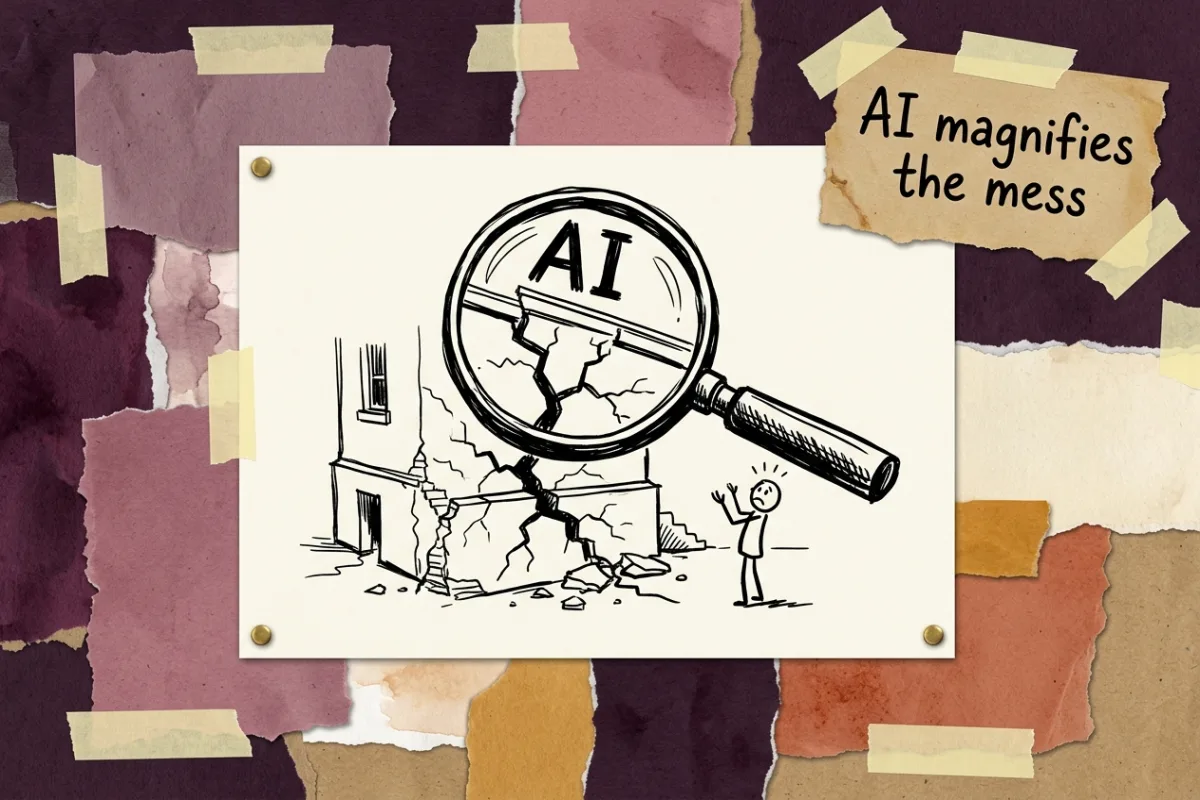
You bought the AI agents. You wrote the prompts. You're producing more output than ever. The output is also more wrong than ever, faster, and you can't tell why.
AI Is Magnifying Your Mess
Layering AI on top of a broken operating system gets you broken faster.
You bought the AI stack. You set up Claude for drafting. You wired up an email triage agent. You built a meeting summarizer that pings Slack. Your Linear is full of AI-generated tickets you reviewed in seven seconds each. You have, by every external measure, "adopted AI."
Things are not better.
They are faster, and they are louder, and they are slightly more wrong than they were a year ago, in ways you can't quite point to. Your team is shipping more output that needs more correction. Your inbox is shorter but the threads are angrier. The strategic decisions you used to make on a Wednesday morning walk are now made by an agent that summarized something you didn't have time to read.
You haven't built a better operation. You've built a louder one.
The problem isn't the tooling.
The problem is that AI is doing exactly what AI does. It's amplifying whatever was already there. And whatever was already there, in your operation, was not as good as you thought it was.
Mel Conway warned you in 1968
In April of 1968, a programmer named Melvin Conway published a paper in Datamation titled "How Do Committees Invent?" The paper was rejected first by the Harvard Business Review for being unsupported by research. Conway published it anyway. The HBR was wrong. The paper now contains the most-cited sentence in software architecture, known to everyone who has ever shipped a large system.
"Any organization that designs a system will inevitably produce a design whose structure is a copy of the organization's communication structure."
Conway's Law. The shape of your software mirrors the shape of your org chart. If your team has three siloed groups that don't talk, your software will have three siloed services that don't talk. If your decisions go through one person, your architecture will have one bottleneck.
Conway wasn't writing about AI. He was writing about anything you build. The work always reveals the structure. You cannot ship better-shaped output than the org that built it.
Now layer AI on top.
The agent you wired up is built in your operating system's shape. It runs your decisions through your communication structure at 100x speed. If your communication structure was broken, the agent is producing broken output 100x faster than the humans were. The humans had a built-in slowness that gave them a chance to notice. The agent has none.
You haven't fixed Conway's Law. You've put it on rails.
Bill Gates wrote the rest of the rule in 1999
In 1999 Bill Gates published Business @ the Speed of Thought, a book that aged better than most of his predictions because it was less about specific technology and more about how organizations absorb tools.
The most useful sentence in the book sits early on, in chapter two.
"The first rule of any technology used in a business is that automation applied to an efficient operation will magnify the efficiency. The second is that automation applied to an inefficient operation will magnify the inefficiency."
Gates wrote that 27 years ago about ERP systems. The rule held for spreadsheets, for the early web, for SaaS, for cloud, for mobile. It is holding now for AI.
If your operating system is good — clear decision rights, written communication, scope discipline, an actual cadence — AI compounds it. Every output is on-brand, on-strategy, on-time. The team gets faster. The work gets better. You feel it in the calendar, in the inbox, in the customer feedback.
If your operating system is broken — undocumented decisions, scattered context, "I'll get to it" defaults, a roadmap that is mostly Slack DMs from your CEO — AI compounds that. Every output is faster but slightly off-strategy. Every email is sharper but slightly off-tone. Every ticket is more detailed but slightly mis-scoped. The team is producing more material at higher quality and the company is somehow getting worse, and nobody can tell why.
You can.
The system underneath is the same system. AI just made it loud.

What the BCG study actually found
In September 2023, a team of researchers from Harvard Business School, MIT Sloan, Wharton, and Warwick — Fabrizio Dell'Acqua and Ethan Mollick among them — published a working paper titled Navigating the Jagged Technological Frontier. The study ran 758 Boston Consulting Group consultants through 18 realistic tasks, half with GPT-4 access and half without.
The results made headlines. Consultants using AI completed 12% more tasks, 25% faster, and produced output rated 40% higher in quality.
The detail that did not make headlines is the more interesting one.
When the team gave the consultants a task that AI was bad at — a task slightly outside what the model could handle — the consultants who used AI did worse than the consultants who didn't. They were 19% less likely to produce a correct answer, because they trusted the agent's confident-sounding output and stopped checking it.
The researchers called this "falling asleep at the wheel." The consultants weren't lazy. They had outsourced the part of the work that was supposed to catch the errors. The agent was confident. The agent was wrong. The consultants couldn't tell, because they had stopped doing the kind of thinking that would have noticed.
That is the gap most senior operators are sitting in right now. The places where your operating system was already weak — the decisions that should have been written down, the strategy that should have been clearer, the scope that should have been locked — are exactly the places where AI is now producing confident-sounding output that you can't tell is wrong.
You can't fix that with a better prompt. The prompt isn't the gap. The gap is upstream.
Three places to look before you buy more tools
You don't need to rip out the AI. You need to look at what's underneath it. Three places.
1. Decision rights. Open a doc. List the last 20 decisions that got made in your operation. For each one, write who actually decided, who should have decided, and what was written down at the time. Most senior operators discover their decision rights are tribal — everyone "knows" who decides, but nothing is documented, and the AI is now defaulting to whatever pattern it pulled out of last week's Slack threads. That's not a tooling problem. That's an undocumented authority problem with a 100x amplifier on top.
2. Scope discipline. Take the last three projects your team shipped or tried to ship. For each one, write the scope as it was at week 1, week 4, and week 8. If those three scopes don't match, you don't have scope discipline. You have scope drift, and AI is now producing perfectly-formatted versions of drifted scope. The Scope Guillotine is the upstream fix. The agent is downstream.
3. Written communication. Look at how strategy moves through your operation. Is it written, in a place anyone can find, with a date on it? Or does it move through DMs, in someone's head, and the occasional all-hands? If it's the second one, your AI is writing context-free output, because there is no canonical context to reference. The fix is a single living strategy doc, updated weekly, that becomes the source the agents pull from. Without it, the AI is hallucinating your strategy back to you.
If any of those three audits made you wince, that's the actual work.
The reframe
You're not behind on AI.
You're catching up on infrastructure that should have been built before AI made the gap visible.
You're not failing at your tools. Your tools are fine. They are surfacing structural cracks that were always there and were always costing you, in slow, untraceable ways, that you used to be able to absorb with personal heroics. You can't absorb them at this speed.
The fix isn't a better agent.
The fix is the same fix it has always been. Write the decision rights down. Lock the scope. Document the strategy where the team can read it. Then let the agent run on top of an operating system that's actually load-bearing.
That's a Build Partnership, not a prompt library.

Pick one of the three audits. Run it this week. See what shows up.
The AI isn't the problem. It's the diagnostic.
More for The Overcommitter
 8 min read
The Infrastructure Mismatch
Why You're a Staff Engineer at Work and a Ghost at Home
 8 min read
You Don't Need a Fractional CTO
What senior tech leaders actually need is a build partner, not another hire.
 7 min read
Stop Hiring Your Way Out of a Systems Problem
Most early-stage founders are trying to hire their way out of a systems problem.
Get one email a week.
A 5-minute read on shipping faster, thinking clearer, and actually finishing what you start. Free.
One a week, give or take. Unsubscribe in one click.
Ready to actually ship?
Reading these essays is the warm-up. Book a free Build Partner call and let's get your project moving.
Request a Free Build Partner Call