
Refactoring Legacy Success
The habits that built the first $1M are the same habits keeping the next $1M stuck.
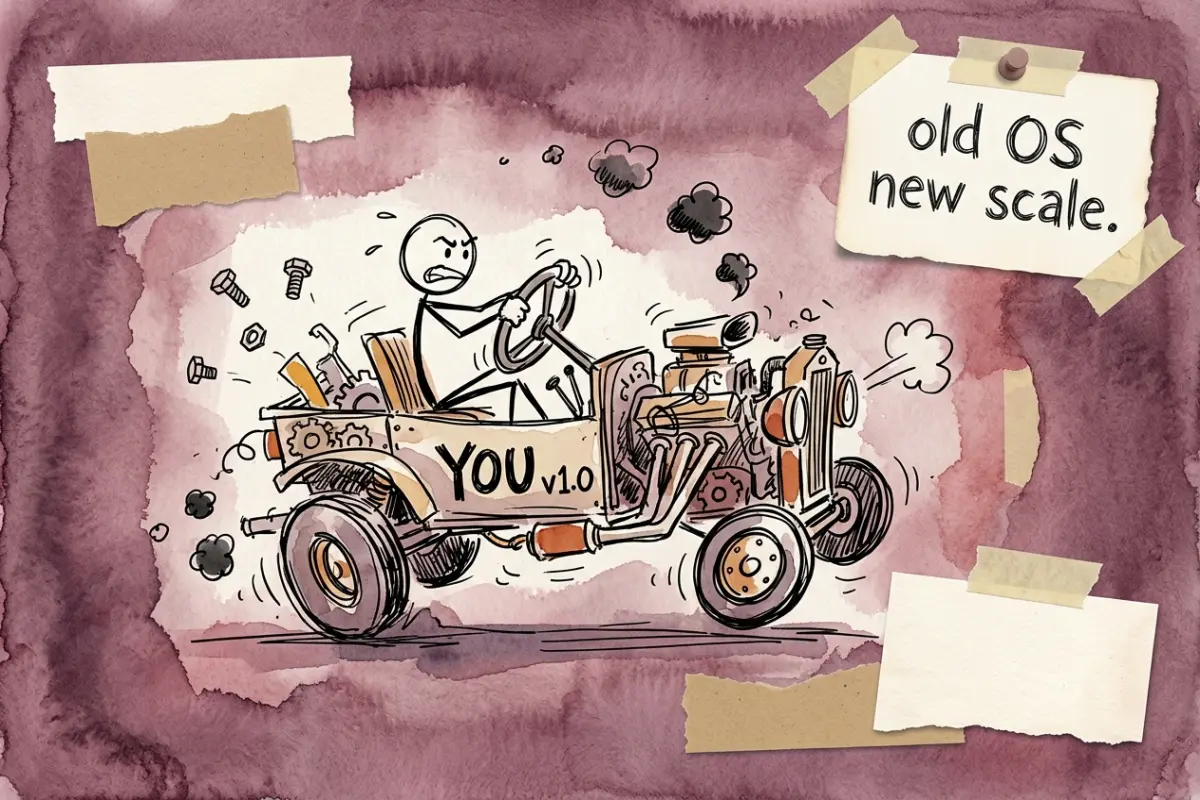
The reason you're white-knuckling a "successful" business is the same reason a 12-year-old codebase falls over every six weeks. Your operating system is from a different version of you.
Refactoring Legacy Success
The habits that built the first $1M are the same habits keeping the next $1M stuck.
You're 41. The business is real. Revenue is up year over year. From the outside, you look like a person who figured it out.
From the inside, you are tired in a way that doesn't make sense to your accountant. The work isn't getting easier as the numbers get bigger. It's getting heavier. You catch yourself thinking if one more thing breaks this week I genuinely don't know what I'll do, then a thing breaks and you fix it the way you've always fixed it. With your weekend. With your back. With the same reflex you used at 28.
You're not undisciplined. You're not burned out from the work.
You're running a 2026 business on a 2014 operating system, and the operating system is what's tired.
Ward Cunningham named the bug 33 years ago
In 1992 a programmer named Ward Cunningham gave a short talk at a conference called OOPSLA in Vancouver. The talk was about a piece of software he'd been writing called the WyCash Portfolio Management System. The clients had wanted features fast. Cunningham had shipped them fast. Some of the code was good. Some of it was a quick hack he'd promised himself he'd come back to.
To explain to his bosses why the next round of features was getting slower, he reached for a financial analogy.
He called the rough code debt. Every shortcut, every hack, every "we'll fix it later" was a small loan. The loans worked. They got the product out. But each one charged interest, and the interest was paid in the form of every future change being a little bit harder than the change before it.
"Shipping first-time code is like going into debt," Cunningham wrote. "A little debt speeds development so long as it is paid back promptly with a rewrite."
That's the bit that gets quoted everywhere. The bit that gets cut from the founder version of the speech is the next sentence.
"Entire engineering organizations can be brought to a stand-still under the debt load of an unconsolidated implementation."
You are an engineering organization of one. The debt load is your reflexes.
Your hustle is the legacy code
Look at how you operated at 28. You were the inbox. You were the sales call. You were the deck. You were the 11pm bug fix. You were the 6am "let me jump on this real quick." When something broke, you absorbed it. When a client was unhappy, you fixed it that night. When a deal stalled, you stayed up to push it.
It worked. It built the thing.
Then it kept working. So you kept doing it.
Now you're 41 and you have a team of seven and a partner and two kids and a mortgage and a series of low-grade physical complaints your doctor calls "stress-related," and the operating system is still: I am the inbox, I am the call, I am the 11pm bug fix.
That's the legacy code. Not your business. Your reflexes.
The habit of being the single point of failure compounds the same way Cunningham's hacks did. Each time you absorb something instead of building a system to absorb it, the cost gets a little higher and the next absorption gets a little harder. By 41 you've got a hundred small loans outstanding and your "calendar problem" is actually compound interest.

What Reed Hastings actually did
In 2020 Reed Hastings co-wrote a book called No Rules Rules with INSEAD professor Erin Meyer. The book is about Netflix's culture, but the most useful chapter for senior operators isn't the famous "no vacation policy" section. It's the part where Hastings describes the period between roughly 2007 and 2011, when Netflix shifted from being a DVD-by-mail company to being a streaming-and-original-content company.
Hastings is candid about what almost killed them. Not the technology. Not the licensing deals. Not the Qwikster spinoff that Wall Street still teases him about.
What almost killed them was that the operating system that had built the DVD business — careful, process-heavy, optimized for cost — was the wrong operating system for the streaming business. The DVD business rewarded the team that filled mailers efficiently. The streaming business rewarded the team that took bigger creative bets faster than competitors could.
Hastings had to do something he writes about as one of the hardest things he's ever done. He had to refactor the company while it was running. He had to take the principles that had worked, tag them as legacy, and explicitly install a new operating system on top.
He calls the new system "high talent density plus context, not control." You don't have to adopt it. You have to notice the move. He named the legacy version. He paid it off. He installed something else.
That is the thing senior founders almost never do for themselves.
What Bill Walsh actually did
Different industry, same lesson.
Bill Walsh became head coach of the San Francisco 49ers in 1979, when the team was the worst in the NFL. By 1981 they had won the Super Bowl. The standard founder-mythology story is that Walsh invented the West Coast offense, his Hall-of-Fame quarterback Joe Montana made it work, and the rest is history.
In 2009, three years after Walsh's death, his book The Score Takes Care of Itself was published from the notes and lectures he had been working on at the end of his life. The argument of the book is that the West Coast offense was not what won the Super Bowl. It was the layer underneath. Walsh had spent his first season as head coach not designing plays but writing what he called the Standard of Performance — a one-document operating system covering how players entered the building, how phones were answered, how meetings started, how losses were processed, how wins were processed, how and when criticism was delivered.
Walsh's claim, repeated for forty years, is that the Standard built the team and the team built the wins. "The score takes care of itself," he said, "if you take care of the standard."
Most senior founders are still optimizing the score. They want a better quarter, a better launch, a better morning routine. The thing that's killing them is the Standard. The standard hasn't been rewritten since they were a 28-year-old kid running a smaller version of a smaller business.

What a refactor actually looks like
You don't fix this with a new planner. You don't fix it with a 5am wake-up. You don't fix it with another offsite. Those are the equivalent of buying a faster monitor for a machine that's running out of RAM.
You fix it with three moves, in order.
1. Find the load-bearing reflexes. Open a doc. List every recurring problem in the business that, when it happens, defaults to you. Inbox triage. Pricing exceptions. The Slack channel that pings you for every new lead. The thing where the bookkeeper texts you on Sundays. There will be 8-15 of these. The list itself is the diagnosis.
2. Tag each one legacy or standard. Legacy means it used to be the right move and now isn't. Standard means it's still genuinely the right thing for the founder to own. Be honest. Most senior operators discover that 70% of their "must own this myself" reflexes are legacy. The pricing-exception reflex is the one I've audited the most often, and the one founders are most attached to. It's almost always legacy.
3. Refactor one a quarter, not all of them at once. Pick the heaviest legacy reflex. Document how it currently works. Build the system that replaces you in it. Run the system. Step back. The whole move takes 6-10 weeks per reflex, which is exactly the cadence of The Build Partnership. Four refactors a year and your operating system is meaningfully different by month 12.
You'll feel withdrawal in the first two weeks. The reflex still wants to fire. Let it pass. The first quarterly refactor is always the hardest because you're not just removing the legacy code, you're disproving the story you've been telling yourself about why you had to be the one to run it.
The reframe
You're not exhausted because the business is too big.
You're exhausted because the business outgrew the operating system you wrote for it when you were a different person, and you've been paying interest on that mismatch for years without naming it.
You're not running out of discipline. You're running out of headroom on a 12-year-old architecture.
Pick one reflex. Tag it. Refactor it. Move on.
The score takes care of itself when you take care of the standard.
More for The Overcommitter
 8 min read
The Infrastructure Mismatch
Why You're a Staff Engineer at Work and a Ghost at Home
 8 min read
You Don't Need a Fractional CTO
What senior tech leaders actually need is a build partner, not another hire.
 7 min read
Stop Hiring Your Way Out of a Systems Problem
Most early-stage founders are trying to hire their way out of a systems problem.
Get one email a week.
A 5-minute read on shipping faster, thinking clearer, and actually finishing what you start. Free.
One a week, give or take. Unsubscribe in one click.
Ready to actually ship?
Reading these essays is the warm-up. Book a free Build Partner call and let's get your project moving.
Request a Free Build Partner Call