
Speed Is Not Direction
AI didn't fix shipping. It just let you ship the wrong thing faster.
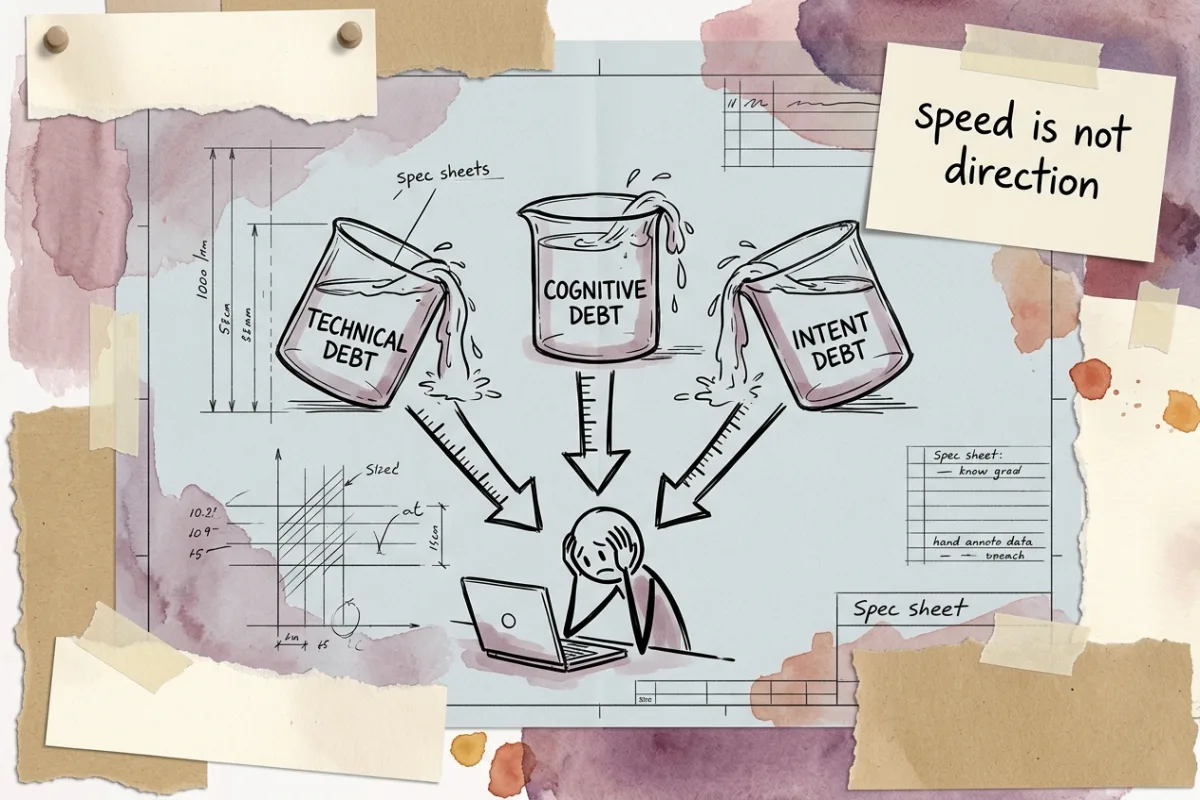
You are shipping more output than ever. The output is also more wrong than ever. Velocity without direction is just an expensive way to fail faster.
Speed Is Not Direction
AI didn't fix shipping. It just let you ship the wrong thing faster.
You are shipping more than ever.
The agents are drafting tickets. The PR queue is moving in 24 hours instead of seven days. The marketing copy is going from brief to live in a single afternoon. Your dashboard tracks three KPIs that all point up. By every velocity metric, you have leveled up. Your peers ask how you're moving so fast.
Your customers are quiet.
The product hasn't gotten meaningfully better in 90 days. The retention number is moving in the wrong direction by half a point. The strategic decision you put off in February is still sitting in your head in May. Your team is exhausted, but they can't tell you what they're exhausted by, because individually each thing was easy.
You don't have a velocity problem. You have a vector problem.
You're going faster in the wrong direction, and AI is the reason you can't tell.
Drucker named this in 1967
Peter Drucker is the only management writer worth reading twice. The first time you read him you think the prose is dry. The second time you realize the dryness is structural. He cuts every sentence to the load-bearing claim and leaves the rest out.
In 1967 he published The Effective Executive. The most-quoted line in the book is also the most useful one for anyone who has ever shipped something nobody asked for.
"There is nothing so useless as doing efficiently that which should not be done at all."
The line is almost 60 years old. It pre-dates email. It pre-dates Slack. It pre-dates the existence of the term "AI" in any modern sense. And it is the most accurate description of what is happening on every shipping team in 2026.
You don't have a productivity problem. The agent is making you 4x more productive at the wrong work. The wrong work, done 4x faster, is not progress. It's a more expensive version of the same mistake.
Drucker's claim is that the difference between an effective executive and an efficient one is the question they ask first. The efficient executive asks "how do we do this faster." The effective executive asks "should this be done at all." The first question is what an AI agent is good at. The second question is what AI cannot do for you, by construction, because the second question requires you to know what you're trying to build.
The agent will help you do anything faster. It will not help you choose what to do.
That part is still your job.
Andy Grove named the right metric
Andy Grove ran Intel from 1987 to 1998. Before that he was Intel's chief operating officer. Before that he was a Hungarian refugee who walked into a Berkeley PhD program with limited English and came out the third employee at Fairchild Semiconductor.
In 1983 he published High Output Management, a book that almost every technical operator under 40 has read at least one chapter of, because Ben Horowitz keeps making people read it. The most useful section is buried in chapter one.
Grove draws a sharp line between activity and output.
Activity is what you and your team did this week. The PRs merged. The meetings held. The decks made. The agents prompted. Activity is easy to measure because it leaves a trail in your tools.
Output is the result those activities produced for the business. Customer outcomes. Revenue. Retention. Strategic position. Output is the thing you can't fake, but is also the thing you stop tracking when activity is high enough to feel busy.
Grove's whole argument is that managers reliably confuse the two. They optimize for activity, because activity is visible, and they wake up two years later wondering why the company didn't move. He saw it at Fairchild. He saw it at Intel. He spent his career building cultures that measured output and tolerated whatever activity produced it.
Now look at your team's last 90 days through Grove's lens.
Activity is up. PRs merged is up. Tickets closed is up. AI usage is up. The dashboard tells a triumphant story.
What's the output? Did the customer's life get measurably better? Did the retention curve bend? Did the strategic moat widen? If you can't answer those three questions in numbers, you don't have a high-output team. You have a high-activity team running on AI fumes.
That distinction is the entire ball game.

What Marty Cagan keeps drilling
Marty Cagan ran product at HP, Netscape, and eBay. He now runs the Silicon Valley Product Group, which has trained product teams at most of the SaaS companies you've heard of. In 2017 he published Inspired, which is the most-circulated PM textbook of the last decade.
His running argument, which he has now been making in essays and conference talks since 2008, is the distinction between output and outcome.
Output is what you ship. The feature. The redesign. The new flow. Output is what shows up in the changelog.
Outcome is what changes for the customer because of what you shipped. The conversion rate. The activation. The retention. The willingness to pay. Outcome is what shows up in the data 30 days later.
Cagan's claim, repeated for 18 years, is that bad teams ship a lot of output and produce no outcome. They have full sprints. They hit their roadmap dates. They report up that everything is on track. The customer doesn't notice. The number doesn't move. Eighteen months later there's a layoff and nobody can quite explain why.
The reason is that the team optimized output and stopped tracking outcome. They mistook activity for impact. The roadmap was a list of things to ship, not a list of changes to drive.
AI is the most powerful output-amplifier ever invented. It will not, by itself, produce a single outcome. The outcome still has to be designed, watched, and corrected for, by a human who is paying attention to whether the work is doing what it was supposed to do. That human is you.
If you stop watching outcomes because the output is so impressive, you will end up with a beautifully-shipped product that your customers don't use, and an AI bill that says you paid full price to get there.

Three moves that fix vector before velocity
You don't slow down. You re-aim.
1. Pick the one outcome that matters this quarter. Not five. One. Write it as a number. "Increase activation from 32% to 45% by July." If you can't write the number, you don't have an outcome — you have a vibe. Without the number, the agents are flying blind on a runway you didn't draw.
2. Cancel one project this week. Look at your active project list. Find the one that, if you killed it today, would not change the outcome you just defined. Kill it. Drucker would approve. The right cancellation is worth two new launches.
3. Run a weekly outcome review, not an activity review. Stop opening Linear at the all-hands. Open the customer dashboard. The team report should be: did the number move, did it move enough, what's the next experiment. This is the reframe Grove made permanent at Intel and Cagan has been preaching for 18 years.
If you can do those three this quarter, AI becomes the leverage tool it was supposed to be. If you can't, AI is a louder failure mode.
The reframe
You're not behind because you're slow.
You're behind because the speed you bought is being applied to work that wasn't going to matter even at slow speed.
You don't need a faster team. You need to choose the right thing to do, lock the scope on it, and let the velocity tools do the boring part on top of a strategy that was already correct.
Speed is not direction. Direction has to come first. Then speed compounds.
Pick the one number. Cancel the one project. Run the one review.
The agent can do the rest.

If you want help finding the one outcome that matters this quarter and cutting everything else, that's what a Build Audit is for.
More for The Burnout Cycler
 8 min read
The Vasa Problem
Why brilliant strategies sink in the harbor, and what the Swedish navy spent 333 years proving.
 9 min read
Burnout Is a Systems Diagnosis
Burnout isn't a character flaw. It's the receipt for an operating system that demanded heroics every day.
 8 min read
Systems Beat Self-Loathing
The 2am self-blame spiral isn't a character flaw. It's the receipt for a system you never built.
Get one email a week.
A 5-minute read on shipping faster, thinking clearer, and actually finishing what you start. Free.
One a week, give or take. Unsubscribe in one click.
Ready to actually ship?
Reading these essays is the warm-up. Book a free Build Partner call and let's get your project moving.
Request a Free Build Partner Call